

This article explains why transportation to MetLife World Cup matches is more complex than the train fare story suggests, and what group organizers should plan for before match week. If you are already evaluating group transportation, BusBank’sFIFA World Cup chartercovers options for groups of all sizes, including New York/New Jersey service where permitted.
Reports published on June 2, 2026, on the New York/New Jersey World Cup transportation plan show that only 17,739 of 320,000 special rail tickets for the eight FIFA World Cup matches at MetLife Stadium had been sold. That is just 5.5% of the available inventory. The same reporting says the usual round-trip fare from New York Penn Station to MetLife is about $12.90, while the special World Cup rail ticket was first set at $150 and later reduced to $98. NJ Transit has also confirmed the $98 round-trip World Cup fare.
While price is the headline, for anyone organizing travel for a supporter club, corporate hospitality group, school, youth soccer team, tour group, or international fan party, the bigger issue is how many constraints have to be managed at once.
Official transportation to MetLife Stadium (called New York New Jersey Stadium during the tournament) is being built around advance purchase, mobile ticketing, match-ticket verification, limited capacity, restricted parking, and controlled movement through transit hubs. Those rules may work for individual fans, but they get harder when one person is responsible for keeping 20, 40, or 50 people together before and after a match.
Groups have different problems than individuals, and the early reaction to the train pricing is a reminder that transportation should not be left until match week.
Table of Contents
The Real Problem Is Not Just Price. It Is Matchday Complexity.
The $98 rail fare gets attention because the contrast is so easy to understand. A short regional trip that normally costs about $12.90 becomes a special-event ticket priced many times higher. Even after the reduction from $150, fans have good reason to ask whether the train is worth it.
Once fans move past the fare itself, the trip is still governed by a tight set of matchday rules.
For example, the NYNJ World Cup Host Committee’s transportation page says there will be no general spectator parking on stadium property on matchdays. It also says a valid FIFA World Cup 2026 match ticket will be required to purchase transportation and access matchday services. Those transportation tickets are non-transferable and checked before boarding.
According to the NJ Transit World Cup rail page, matchday service to the stadium is available only to match ticketholders with a valid NJ Transit rail ticket to NYNJ Stadium. Tickets are limited to 40,000 per matchday and must be purchased in advance through the NJ Transit mobile app. They will not be sold at stations or onboard trains.
This means fans are not simply choosing between “train” and “no train.” They are choosing between a set of planned, limited, rules-based options:
- Buy the special NJ Transit rail ticket in advance through the mobile app.
- Use the Official NYNJ Stadium Shuttle, also purchased in advance.
- Use rideshare or taxis, with restricted access and a longer walk from designated zones.
- Secure limited off-stadium parking where available.
- Arrange private transportation only for permitted routes or surrounding group movement after confirming the event’s access, staging, and drop-off rules.
This could work for a solo fan, but for a group organizer, flexibility disappears quickly. If 30 people confirm match tickets at different times, use different phones, arrive through different hotels, or miss different boarding windows, the transportation plan starts to fragment before anyone reaches the stadium.
Why Group Travel Is Different From Individual Travel
Group transportation fails in ordinary ways.
One person does not have the app. Someone’s phone battery is low. A family in the group is still waiting on one match ticket. A few people want to leave from a hotel instead of Penn Station. Someone gets delayed at security or heads to the wrong queue. After the match, half the group moves faster than the other half.
None of these problems is dramatic on its own. In a large crowd, they compound.
A single fan can adjust on the fly. A tour leader, school chaperone, supporter club organizer, or corporate host has to think about the whole group:
- Where does everyone meet?
- Who has the transportation tickets?
- Does every traveler understand the boarding process?
- What happens if the group is split into different queues?
- How does everyone regroup after the match?
- Who is responsible for the final headcount?
The app-only piece is especially important. A transportation plan that depends on every individual traveler downloading an app, managing a digital ticket, keeping a phone charged, and arriving during the right window is different from a plan controlled by one group organizer.
For an organizer, the cleaner plan is usually the one that puts fewer tasks on each traveler. The more the trip depends on every person making the same purchase, finding the same queue, and leaving at the same time, the more fragile the plan becomes.
International Fans And Tour Groups May Face Extra Friction
World Cup matches bring different kinds of travelers into a local transit system.
Many international fans may be visiting the region for the first time, using an international phone plan, or coordinating in another language. Some may be staying outside Manhattan. For these travelers, transportation confidence often matters early because flights, hotels, match tickets, and local movement all have to line up.
That creates practical friction:
- A mobile app may be easy for locals but less obvious for international visitors.
- Mobile data and roaming become part of the transportation plan.
- Matching official transportation purchases to FIFA match tickets can add another step.
- Penn Station, Secaucus Junction, and the Meadowlands are not intuitive for every visitor.
- A group organizer may need one plan for dozens of people arriving from multiple hotels.
Official transit may still work, but group organizers need to account for who is traveling, how familiar they are with the region, and how much help they may need moving through the system.
If the group includes international fans, families, children, older travelers, or people unfamiliar with the region, fewer moving parts matter more than the route itself.
Post-Match Logistics: Where The Real Pressure Builds
Getting to the match is only half the job. The harder move is often after the final whistle, when tens of thousands of people leave the stadium at the same time.
For rail riders, the matchday route from New York Penn Station connects through Secaucus Junction, where fans transfer to stadium service. After the match, return service from the stadium to Secaucus Junction is scheduled to operate frequently for about three hours, with return movement by train or bus depending on the loading process.
For a group, Secaucus is a coordination point, and it can get complicated quickly. People walk at different speeds. Platforms fill. Some travelers stop for restrooms or food. Others move ahead. The group that arrived together can become a group that returns in pieces.
Rideshare is not a simple fallback either. Uber and rideshare pickup and drop-off will take place off stadium property at Meadowlands Racing and Entertainment, with a 1.3-mile walking path to the stadium gates. Fares and wait times are expected to be higher than usual before and after matches.
Online discussions show why fans are sensitive to this part of the plan. The region has struggled with crowd movement after major MetLife events before, including Super Bowl XLVIII in 2014. That does not mean the World Cup system will fail, but it helps explain why many fans are asking hard questions about the return trip before the tournament starts.
For groups, the lesson is simple: plan the departure as carefully as the arrival.
Official Buses Are Already Part Of The Answer
One of the clearest signs that bus transportation matters in this plan is the official shuttle response.
The Official NYNJ Stadium Shuttle was originally priced at $80 round trip, then reduced to $20 with support from New York State and sponsors. A New York State announcement said shuttle capacity was expanded from 10,000 seats to 18,000 seats for five matches and 12,000 seats for three matches. It also said 20% of shuttle tickets for each match would be reserved for New York State residents.
Buses are already being used to create a lower-cost, one-seat ride from selected pickup points in New York and New Jersey.
That does not mean official shuttles and private charter buses operate under the same rules. Access, routes, parking, staging, and drop-off permissions may differ, and unofficial vehicles may be restricted from stadium facilities. Any private group transportation plan needs to confirm the event’s current access rules before it is shared with travelers.
But the shuttle program does show the logic behind bus-based movement: when many fans need to go to the same place at the same time, a planned bus system can reduce the number of individual decisions required.
For organized groups, private charter transportation applies the same logic to the parts of the trip where private group movement is permitted.
Where Charter Buses Fit Into The Conversation
A charter bus is not the right answer for every fan going to MetLife. It also does not bypass official event rules or stadium vehicle restrictions. Its role is narrower and more practical: it can help organized groups turn dozens of individual transportation decisions into one plan for the permitted parts of matchday travel.
For a supporter club, that may mean a single departure from a hotel, pub, fan event, or meeting point. For a corporate hospitality group, it may mean keeping clients together and avoiding a confusing post-match return. For a school or youth soccer group, it may mean better headcounts and clearer supervision. For a tour operator, it may mean moving international visitors without asking each traveler to manage a local transit app and transfer sequence on their own.
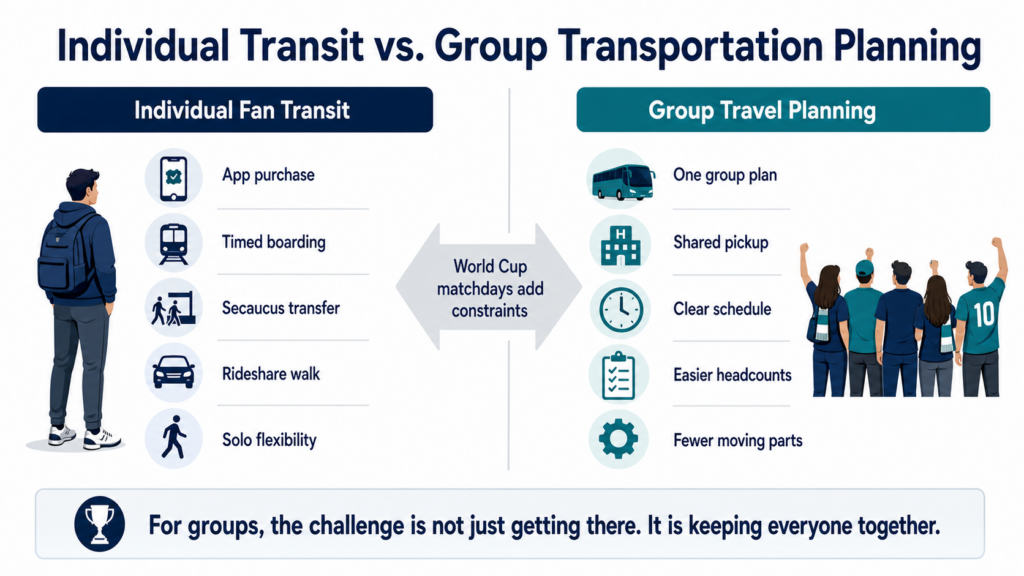
The coordination advantages are practical:
- one pickup location or planned set of pickups
- one departure time
- one return plan
- one communication plan
- one place for the group to regroup
- fewer individual ticketing and app dependencies
- fewer chances for the group to split apart in a crowded transit hub
If the group is small, comfortable with transit, and staying near a shuttle pickup point, official transportation may be the cleanest choice. If the group is larger, spread across hotels, responsible for children or guests, or coordinating airport, hotel, fan-event, or pre/post-match movement around the match, charter bus service in New York City may be worth evaluating early.
The details still matter. Charter access, staging, parking, permitted drop-off locations, timing, vehicle size, and operator availability all need to be confirmed before a group tells travelers what to expect. If unofficial vehicles are barred from a stadium zone, a charter plan may need to focus on airport transfers, hotel movement, fan events, or connections to approved transportation options rather than direct stadium service.
What Group Organizers Should Verify Before Match Week
The biggest mistake is treating transportation as the final item on the checklist. For MetLife World Cup matches, group organizers should verify the following before match week:
| Planning item | Why it matters |
| Final match ticket count | Official transportation access may depend on valid FIFA match tickets. |
| Group size and traveler mix | Families, children, international fans, VIPs, and older travelers may need different planning assumptions. |
| Official NJ Transit rules | Confirm fare, mobile app requirements, boarding zones, Secaucus transfer details, and return service windows. |
| Official shuttle availability | Pickup points, capacity, and ticket availability may vary by match. |
| Rideshare and parking rules | Stadium access is restricted, and off-property movement may involve walking distance. |
| Charter access and staging | Confirm whether private vehicles are allowed at all, and if so, whether they can use approved drop-off zones, adjacent staging areas, or off-site locations. |
| Accessibility needs | Boarding time, walking distance, vehicle choice, and pickup location can all change when accessibility is part of the plan. |
| Return instructions | Tell the group how and where to regroup before the match begins, not after it ends. |
| Communication plan | Large crowds make vague instructions fail quickly. Use clear meeting points, times, and backup contacts. |
Not every match will create the same transportation pressure. Higher-demand games, knockout rounds, and the final can compress availability faster than lower-demand matchdays, so group organizers should not treat the overall rail-sales figure as a guarantee of easy planning.
If you are organizing travel for a group, the goal is not to guess which option everyone else will choose. The goal is to build a plan that works for your group’s size, timing, origin, and flexibility.
The Bottom Line: MetLife Travel Rewards Early Planning
The train-ticket backlash is a planning signal. Official rail and shuttle options will be the right fit for many fans, but groups have a different job. They need to keep people together, reduce confusion, manage the return, and make sure the plan survives the actual crowd conditions around the match.
That is where charter bus transportation can still fit: not as a universal substitute for public transit or official shuttles, but as a coordinated option for permitted group movement around the match. For those groups, the right time to evaluate transportation is before match week, while there is still time to confirm tickets, access rules, vehicle availability, pickup points, and return instructions.
At a World Cup match, the transportation plan should not become the story of the day. It should get the group there, get the group back, and stay out of the way.
FAQs
Why are 2026 World Cup train tickets to MetLife getting so much attention?
The reported price difference is the main reason. A regular round-trip from New York Penn Station to MetLife is about $12.90, while the special World Cup rail ticket was initially reported at $150 and later reduced to $98. Early rail sales have also reportedly lagged behind the planned 40,000 rail riders per match.
Can fans still use NJ Transit to get to MetLife for World Cup matches?
Yes, but fans should follow the official NJ Transit World Cup process. NJ Transit says matchday stadium service is limited to FIFA match ticketholders with a valid NJ Transit rail ticket, and tickets must be purchased in advance through the mobile app.
Are private charter buses allowed for World Cup matchdays?
Private charter buses do not have the same access as the Official NYNJ Stadium Shuttle. Drop-off on stadium property is restricted to officially permitted vehicles, and unofficial vehicles may be barred from stadium facilities. Groups using private charter operators should confirm current event access rules, permitted staging areas, and any registration or insurance requirements before presenting a plan to travelers.
Is the Official NYNJ Stadium Shuttle different from a private charter bus?
Yes. The Official NYNJ Stadium Shuttle is part of the Host Committee’s transportation program and has its own routes, ticketing rules, and access arrangements. Private charter buses are separate and must follow whatever event access, parking, staging, and drop-off rules apply.
When does a charter bus make sense for World Cup travel?
A charter bus makes the most sense when a group needs to travel together from a hotel, event, school, office, fan gathering, or regional pickup point on a route that is permitted under event rules. The main advantage is coordination: one planned schedule, one pickup structure, and fewer individual app and transfer dependencies.
What should group organizers confirm before booking transportation?
Confirm final headcount, match tickets, official transportation rules, pickup and return timing, accessibility needs, and whether private vehicles are allowed to use any approved drop-off zones or nearby staging areas. For World Cup matches, access rules can matter as much as the route itself.