


New York does not make group transportation hard due to distance. A Midtown hotel to a Financial District venue is a short ride. An office pickup for a client dinner is often a few miles. The problem is everything that sits between the curb and the destination: loading zones that disappear, multi-hotel pickups across dense blocks, groups that arrive at an event together and leave it in every direction, strict no-idling enforcement that limits how long buses can wait curbside, and a city that gives buses almost no room to wait while the plan catches up with reality.
That is the New York corporate group problem. Not the route. The margin.
This guide is for corporate planners and group coordinators managing that kind of movement in New York. It covers hotel and office departures, event-night returns, multi-stop business days, sports and entertainment-linked outings, and the vehicle and service decisions that keep a New York group on schedule from the first pickup through the last return. If you are evaluating charter bus service in New York City, the goal here is to help you build the day before you book it.
Table of Contents
What Corporate Group TravelUsually Looks Like In Our New York Booking Data
Our New York corporate bookings cover a wide range of business-day movement. Group sizes run from 10 to 299, with a median around 60. Mini buses appear most often in the mix, followed by deluxe motorcoaches, sprinter vans, and executive coaches.
The patterns that repeat across those bookings are consistent:
| Movement type | What drives the booking |
| Hotel-to-venue transportation | Groups that need to arrive together on a fixed schedule |
| Office-to-off-site movement | Business-day transfers where timing and stop sequence matter |
| Multi-stop corporate itineraries | Full-day programs that span meetings, off-sites, and events |
| Event-night returns | Post-dinner, post-game, and post-show group pickups |
| Sports and entertainment-linked outings | Games, shows, and private venue movement |
| Airport-linked business travel | Executive arrivals or departures tied to a broader itinerary |
The shared thread across all of these is control. The group needs to board together, arrive on time, and return without falling apart at the end of the day. In New York, the planning required to make that happen is almost always more than the distance suggests.
Planning Corporate Event Transportation In Manhattan And Beyond
New York group transportation is defined less by mileage than by loading, access, and route timing inside dense operating zones. Each part of the city creates a different planning problem.
| Area | Key locations | Main transportation challenge |
| Midtown | Times Square, Grand Central, Hudson Yards, hotel corridor | Tight loading windows, fast curb turnover, and heavy pedestrian flow leave little room for a plan that depends on the bus waiting. |
| Javits / West Side | Javits Center, Pier 94, Convention corridor | Designated access zones and convention traffic create staging conditions that are more controlled and less flexible than standard curbside loading. |
| Downtown / Financial District | Wall Street, The Battery, Fulton area | One-way streets, narrow blocks, and business-hour parking restrictions make loading harder than the short distances suggest. |
| Theater District | Broadway corridor, Times Square venues | Post-show simultaneous release sends thousands of people onto the same streets at once. Group pickup here requires a confirmed staging point before the curtain comes down. |
| Waterfront / Pier venues | Hudson River piers, Chelsea Piers, Pier 17 | Access runs from the west side only, staging space is limited, and no-wait enforcement near piers means the bus cannot simply hold at the drop-off point. |
| Brooklyn / Outer Boroughs | DUMBO, Williamsburg, Flushing Meadows, Long Island City | Bridge and tunnel timing adds unpredictability that does not show up in a standard driving estimate, and return windows are less forgiving than Manhattan-only routes. |
| Airports | JFK, LaGuardia, and Newark | Staggered arrivals, luggage, and transfer times to Midtown that consistently run longer than expected make airport legs a planning problem as much as a transportation one. |
Corporate days in New York often cross several of these zones in the same itinerary. An office departure in Midtown, a client visit downtown, and an evening event in Brooklyn is not one route. It is three distinct operating conditions, and each one needs to be planned on its own terms.
NYC Loading, Idling, And Layover Rules Every Planner Should Know
New York’s operating rules for charter buses are specific and enforced closely enough to shape the plan. These rules directly determine where the bus can be, how long it can stay, and what documentation the operator needs to carry.
Loading and drop-off. Charter buses are required to perform expeditious passenger pick-up and drop-off only. Lingering in travel lanes, stopping in crosswalks, or occupying MTA bus stops is not permitted. Once passengers are loaded or discharged, the vehicle must immediately relocate to a legal layover or metered spot.
Idling. New York City prohibits bus idling for more than three minutes at most locations, and one minute near schools. Exceptions apply only when the temperature is at or below 40°F for passenger or vehicle safety. Fines range from $350 to over $2,000. The practical rule: have the group assembled and ready before the bus is called into position.
Metered bus parking. Most metered bus parking spots carry a three-hour maximum, billed at approximately $20 per hour via the ParkNYC app or meter. Double-parking is prohibited at all times. The staging plan needs to account for a legal and available spot, not just a convenient curb.
Layover locations. The NYC DOT publishes an official list of approved charter bus layover locations that is updated periodically. In Midtown West, examples include segments of West 38th through 59th Streets between 9th and 12th Avenues and portions of 1st Avenue between 38th and 41st Streets. Lower Manhattan has more limited options, with tighter metered spots and stronger reliance on private off-street lots. Confirm current availability against the NYC DOT layover map before finalizing the staging plan, as locations can change.
Javits Center staging. Drop-off and pick-up at the Javits Center uses the designated service road on the west side of 11th Avenue between 34th and 39th Streets. On-site staging is limited, and full coaches typically need a remote layover rather than holding near the building.
Route slips. Operators in Manhattan are required to carry a route slip documenting the origin, destination, and intended streets for the trip. It must be producible on request. Confirm with the operator that the route slip is prepared before the first departure.
Multi-Hotel Pickups Are A Real New York Problem
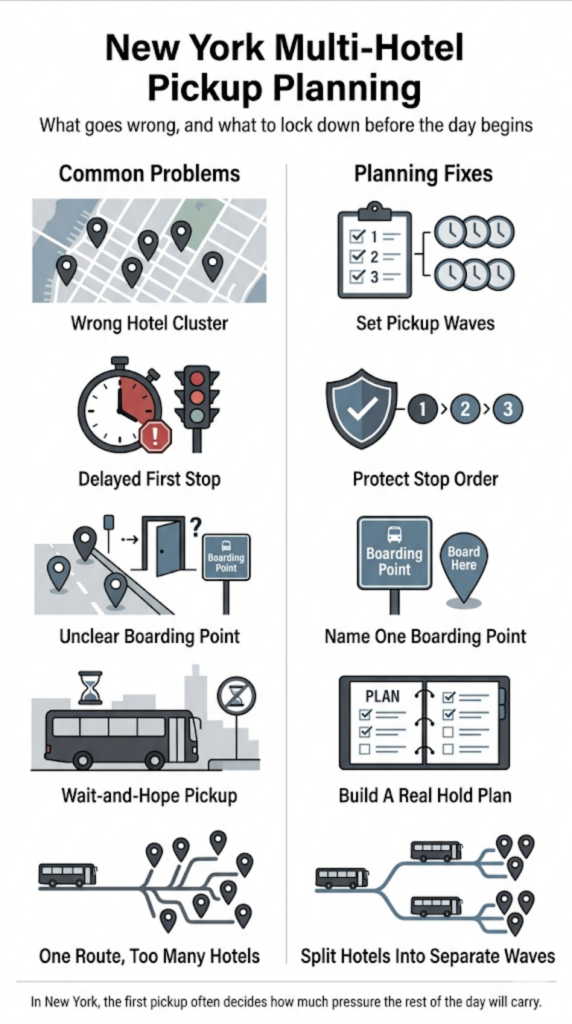
Multi-hotel pickups in New York create more friction than planners expect because the city does not forgive loose boarding plans. Common failure points include:
- hotels that are close on a map but operate on different curb conditions
- one late or blocked pickup that pushes every stop after it
- attendees who know the hotel name but not the exact side of the block or loading point
- a group that assumes the bus can wait while people trickle down
- two or three hotels treated as one easy cluster when they need separate waves
Manhattan punishes assumptions. A pickup can fail without the route ever being long. The bus can be on time and the plan can still slip because the curb was wrong, the group was not assembled, or the instructions were never specific enough to survive actual street conditions.
Before the day begins, planners need to decide:
- which hotels actually belong in the same pickup wave
- whether one consolidated departure is realistic or whether staggered waves are cleaner
- the exact stop order
- the specific boarding point at each property
- how each hotel’s guests receive their instructions
When those decisions are vague, the first stop creates pressure that stays with the group for the rest of the day.
Managing Event Nights, Sports, And Theater District Movements
The return is where New York group transportation gets harder.
The outbound trip to a dinner, private event, show, game, or waterfront venue is usually the simpler move. The group is still together, the departure is structured, and the timing is known. The return comes later, when attendees are tired, release times are less predictable, rideshare demand spikes across the whole neighborhood, and the bus may not be able to sit where everyone expects it to be.
In our New York bookings, Mets and US Open transportation, hotel-to-pier service, and event-night movement all point to the same planning problem: getting the group out cleanly after the program ends, not just in.
Theater district and Broadway movement works the same way operationally. A show-night return is less about getting the group into Midtown and more about what happens when the curtain comes down and the group leaves into one of the city’s tightest evening traffic environments — alongside thousands of other theatergoers doing the same thing.
What the planner needs to lock down before the event starts:
- the exact pickup point
- whether the return runs in one wave or several
- how attendees know which vehicle they are boarding
- what happens if someone misses the first departure window
In New York, the return plan needs more discipline than the outbound plan. That is where the day either holds together or does not.
New York Group Experiences Worth Adding To The Itinerary
New York is one of the few cities where the group transportation plan and the group experience plan genuinely reinforce each other. When the transportation is already structured for the day, adding an off-site outing, an entertainment event, or a themed evening does not create a new logistics problem. It slots into one that already exists.

Our partner Viator offers a range of New York City experiences that pair well with planned corporate and group travel. The ones below work best because they have a defined venue, a predictable end time, and a pickup structure that fits naturally into an existing transportation plan.
| Experience | Best for | What makes it work for groups |
| City Cruises New York: Bateaux Premier Dinner Cruise | Client dinners, sponsor hosting, evening corporate groups | Works well because the boarding point is fixed, the event has a defined end time, and the transportation plan can be built around one structured arrival and one structured return. |
| Manhattan Architecture Yacht Cruise | Executive groups, client entertainment, smaller curated outings | A strong fit for smaller groups that want a distinct New York experience without creating a multi-stop transportation problem. One departure point and one return point keep the movement clean. |
| Top of the Rock VIP Tickets with SKYLIFT and The Beam Experience | Leadership groups, premium attendee add-ons, shorter off-site windows | Sits in the middle of Midtown, which means it pairs naturally with a hotel departure or a client dinner without adding cross-borough movement to the day. Duration is short enough to slot into a structured itinerary without disrupting the rest of it. |
| Greenwich Village Food Tour | Smaller executive groups, team outings, hosted client groups | Arrival and return are straightforward because the experience stays within one walkable neighborhood. A good fit when the group wants something grounded and local without creating a multi-stop transportation problem. |
| Deluxe Manhattan Helicopter Tour | VIPs, senior leadership, premium client entertainment | This is a narrow use case, but it fits high-touch itineraries because the meeting point is fixed, the experience is short, and the surrounding transportation can be handled with a very precise schedule. |
In New York, the experience options are broad enough that the choice can become a planning problem of its own. The ones that hold up best in a corporate context are those with a defined start, a predictable end time, and a clear pickup point, so the transportation plan you already built does not have to be rebuilt around the activity.
Handling Airport And Multi-Stop Business Itineraries
Airport-linked transportation in New York changes the rest of the business day even when the airport is not the main event.
In our New York bookings, airport movement appears as part of broader business itineraries: executives arriving for a multi-day program, departures after meetings, or airport legs that feed into a dinner or event later the same day. Once an airport transfer connects to hotel check-in, a client meeting, an off-site, or an evening event, the planning pressure moves away from the airport itself and into sequencing.
Four things planners regularly underestimate on airport days in New York:
- Luggage changes vehicle fit. A group whose headcount fits a sprinter van may need a larger vehicle once bags are in the equation.
- Staggered arrivals change the pickup window. If the group is coming in on different flights, a single pickup time forces a choice between leaving early arrivals waiting or dispatching before everyone has landed.
- Same-day sequencing leaves no slack. An airport leg that feeds into a hotel check-in that feeds into a business dinner has no recovery time built in.
- New York traffic is not predictable. The gap between JFK or EWR and Midtown looks manageable on a map and can be anything but.
Treat the airport leg as the first move of a longer plan, not a standalone transfer, and build the rest of the day’s timing from a realistic read of how long that first move actually takes.
Choosing The Right Vehicle And Service Window
In New York, the vehicle choice and the service window are part of the same decision.
A mini bus (15 to 35 passengers) is the most common vehicle in our New York corporate bookings for practical reasons. Much of New York corporate group movement sits in the range where the group is too large for cars but small enough that a mini bus fits the access conditions better than a full coach. Hotel pickups across tighter-block neighborhoods like the Flatiron District, NoMad, SoHo, and Tribeca, mid-block office departures, and event-night returns from boutique venues all tend to favor a mini bus over anything larger.
A full-size motorcoach (45 to 56 passengers) is the right answer when the movement is consolidated and throughput is the priority. Large-scale departures from major venues — Madison Square Garden, Yankee Stadium,Barclays Center,Citi Field — or high-volume hotel clusters where the group is large enough to fill the capacity efficiently are where coaches earn their place in the plan.
A sprinter van (8 to 14 passengers) covers the smaller, higher-precision end of the market. Executive arrivals heading to Park Avenue headquarters, client groups moving between Rockefeller Center meetings and private Tribeca dinners, and VIP movement at venues where a larger vehicle creates more visible friction than the situation warrants are all better served by a sprinter than by a bus.
The other half of the decision is the service window. Point-to-point service works when the route is one move with a known start and end. Hourly or waiting-time service makes more sense when the day includes several stops, uncertain release timing, or a return that cannot be predicted to the minute. In New York, a bus often cannot simply wait where it loaded, so if the day is multi-stop or event-linked, dedicated service time is usually cleaner than treating a complex itinerary as a simple transfer.
New York Booking And Operations Checklist
Before the day starts, the transportation plan should lock down the items below.
| Planning item | Why it matters in New York City |
| Final headcount | Vehicle choice and boarding flow only work if the real group matches the plan. |
| Hotel or office pickup plan | In New York, the pickup point is often as important as the route. |
| Loading-zone confirmation | The workable curb may be different from the most obvious one, and it may not be available for the return. |
| Venue access assumptions | A venue can be easy to reach and still hard to load cleanly. |
| Waiting-time or layover plan | The bus may need to relocate rather than stay at the first loading point. |
| Route sequencing | Multi-stop days slip quickly when the stop order is loose. |
| Event-night return instructions | The return works better when attendees know the pickup point before the program ends, not after. |
| Cross-borough timing assumptions | Bridge and tunnel movement adds uncertainty that does not show up in a standard driving estimate. |
| Accessibility needs | Boarding time, stop choice, and route execution may all shift when accessibility is part of the plan. |
| Contingency plan for delays | New York schedules need a backup plan because one blocked stop can affect everything after it. |
Conclusion
Corporate events and group travel in New York work best when transportation is planned early and treated as part of how the day operates.
The strongest plans protect schedule integrity, keep the group together, and reduce the friction that makes an event feel disorganized. That means deciding the pickup structure early, being realistic about loading and curb conditions, and giving the return the same level of planning as the outbound trip.
When that work is done, the group arrives together, the event runs on time, and transportation stays where it belongs: in the background.
FAQs
When does a charter bus make more sense than rideshares in New York City?
When the group needs to arrive together, board from one known place, and return on a coordinated schedule. Rideshares can absorb smaller or looser movement, but they become unreliable once the group is large, the timing is fixed, or the event ends with everyone trying to leave at once into a city where demand surges at exactly the same moment.
How should planners handle multi-hotel pickups in Manhattan?
Treat them as a sequencing problem, not just a pickup list. Group the hotels logically by location and curb conditions, confirm the exact stop order, assign one named boarding point per property, and send instructions to attendees before the morning begins. If the first pickup slips, the rest of the day absorbs that pressure.
What changes when the event ends late and attendees leave in waves?
The return becomes harder than the outbound trip. The pickup point needs to be clearly communicated before the event ends, the group may need more than one departure wave, and the bus may not be able to wait in the most obvious spot. The more vague the return plan, the more New York amplifies that confusion.
How should cross-borough off-sites be timed?
More conservatively than Manhattan-only movement. Cross-borough routes add unpredictability through bridges, tunnels, and less consistent staging conditions on the far side. The time buffer needs to account for more than the map distance, and the return leg deserves the same caution as the outbound.
When does a minibus make more sense than a full-size coach?
A minibus is often the better fit when the group is moderate in size and the plan depends on tighter loading conditions, more flexible routing, or a return that happens in smaller waves. A full-size coach is the cleaner choice when the movement is consolidated enough to fill it and throughput matters more than flexibility.
How should airport transfers be handled when they are part of a broader business itinerary?
As part of the full day rather than a standalone move. Luggage, staggered arrivals, and the timing pressure of the next stop all affect the vehicle and the service window. Treat the airport leg as the first move of a longer plan, build the day’s timing from a conservative read of how long it actually takes, and do not assume the schedule has slack it does not have.