

Most cities have transportation problems. New Orleans has transportation conditions, and those conditions can change before the first bus moves.
A parade closure can cut off the route the shuttle plan assumed was available. A festival staging zone can shift the drop-off point by three blocks. Post-event congestion can stack on top of residual parade closures and make the curb that worked at 6pm unreachable at 10pm. In most cities, those are edge cases. In New Orleans, they are the baseline operating environment for any large-group transportation program.
This guide is for convention planners, event teams, and operations staff managing group movement in New Orleans. It covers the scale and continuity demands of large-event shuttle programs, how closure and parade conditions change the routing logic, what it takes to control crowd dispersal when hundreds of people try to leave at once, and the planning decisions that determine whether the shuttle program holds or becomes the story of the event.
If you are evaluating charter bus service in New Orleans, the goal here is to help you shape the operating plan before you book it.
Table of Contents
What Large-Group Event Shuttle Programs Look Like In Our New Orleans Booking Data
The New Orleans bookings in our data point to the same service types: all-day continuous service, several buses operating across a full weekend, parade-related routing, and multi-day conference and convention support movement.
Group sizes in the large-event subset range from 90 to 1,210 passengers. A group of 90 needs a clear shuttle plan. A group of 1,210 needs a program designed around continuous flow, because the scale makes ad hoc coordination impractical regardless of how straightforward the route looks.
The vehicle mix is split between deluxe motorcoaches and mini buses, which reflects the service reality directly: large-scale throughput for main movement, smaller vehicles for tighter access conditions and secondary waves. The recurring planning challenge across these bookings is scale and continuity. Keeping people moving across several hours or several days without losing control of access, timing, or return flow takes a different level of planning than a clean hotel-to-venue departure.
When Groups Usually Need Event Shuttles In New Orleans
Event shuttles in New Orleans tend to show up when the group is large enough that attendee flow has to be actively managed.
| Use case | What makes it a New Orleans problem | Why it matters |
| Convention hotel loops | High-frequency throughput across a multi-hotel cluster near the Convention Center | The work is keeping repeated attendee waves moving without gaps, confusion at curbs, or one slow hotel holding up the entire loop. |
| Event-night dinners and private events | Return logistics after a long event day in a city where curb access changes quickly | The outbound trip is usually manageable. The return is where staggered departures, fatigue, and tighter access conditions converge. |
| Parade and staging transportation | Route logic built around a city that has already reorganized itself before buses move | These routes are shaped by staging conditions, closure windows, and production timing, not distance. Normal map logic does not apply. |
| Festival-related movement | Volume sustained over many hours, not a single transfer | The shuttle program needs to hold under repeated waves of movement across the day, not just cover one departure and one return. |
| Weekend-long shuttle operations | Dispatch, assignment, and signage that stay coherent across multiple days and service windows | Continuity is harder than a single-day plan. Legibility has to survive repeated use by both staff and attendees. |
| Event-finish crowd dispersal | A controlled pickup structure for a simultaneous mass release into a city that may still have active closures | The hardest move is often the final one, when the largest number of people and the tightest access conditions exist at the same time. |
Once the transportation program has to manage attendee flow, the planning work changes. The shuttle system has to be structured to hold under the actual event conditions.
Planning Convention Hotel-To-Venue Loops
Convention shuttle service in New Orleans is a hotel-cluster problem before it becomes a route problem.
The geography matters directly. The Ernest N. Morial Convention Center, the Warehouse District, and the CBD hotel cluster create one of the city’s most recognizable shuttle patterns: repeated circulation between several hotel bases and a concentrated event footprint. On paper, that looks manageable. In practice, the pressure lands on curb space, stop sequencing, loading speed, and keeping the route legible to attendees who may board from different properties across the full service day.
New Orleans does not treat large shuttle programs as casual curbside movement. The Convention Center’s Transportation Center and managed shuttle infrastructure are reminders that repeated group movement has to be staged and organized, especially when several vehicles are running the same program at once.
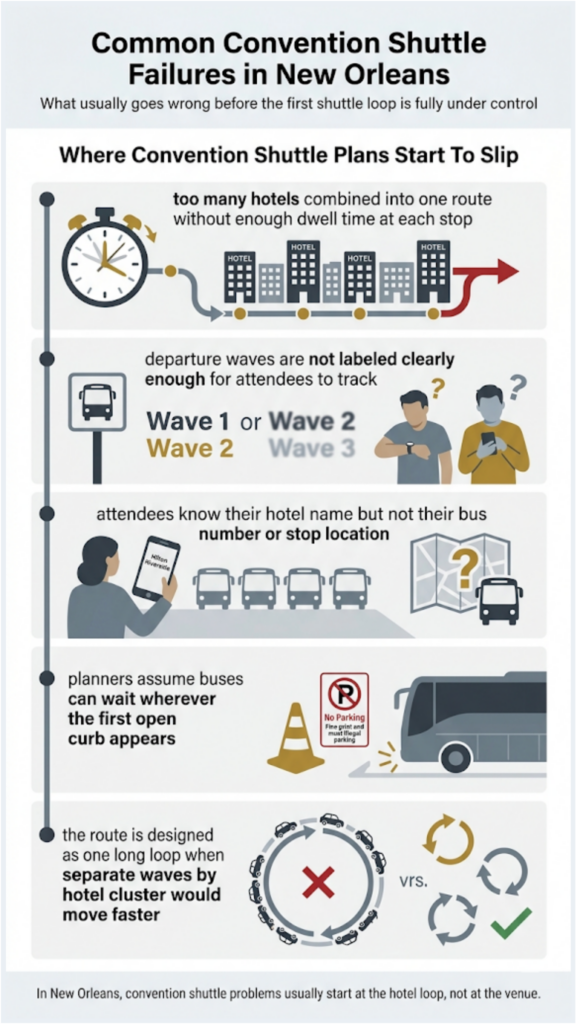
The common failure points are predictable:
- too many hotels are combined into one route without enough dwell time at each stop
- departure waves are not labeled clearly enough for attendees to track
- attendees know their hotel name but not their bus number or stop location
- planners assume buses can wait wherever the first open curb appears
- the route is designed as one long loop when separate waves by hotel cluster would move faster
Convention transportation in New Orleans works better when hotel grouping, stop order, and return logic are decided before the first morning of service, not during it.
How Parade, Festival, And Closure Conditions Change The Planning Logic
This is where New Orleans stops behaving like any other downtown shuttle market, and where planners who have run large groups in other cities often get caught.
Parade and festival conditions change route access before the event begins. A shuttle plan built around normal street logic is already operating on incorrect assumptions. The main planning questions are:
- when closures begin to affect the planned route
- where buses can legally stage before pickup
- how close the vehicle can actually reach the drop-off point once closures are active
- whether the attendee walking path from the nearest accessible drop-off to the event entrance still works once staging is in place
The Krewe of Freret booking in our New Orleans data is the clearest version of this. The task involved routing from NOMA to a staging area under parade conditions, managing pickup after the event, and making the return leg work once the city’s normal access pattern had shifted. That is a fundamentally different planning problem from a point-to-point transfer between two fixed addresses.
The same logic applies to festival weekends and closure-heavy event windows. The shuttle plan has to be built around the closure schedule rather than corrected in real time once the buses are already on the road. That is especially important near the French Quarter edge and other tighter corridors, where larger coaches have limited repositioning options once access changes.
The practical rule is straightforward: treat closure timing as an input to the route plan, not a variable to monitor after the plan is already set.
Managing Event Nights, Dinners, And Private Events
Event-night transportation in New Orleans usually turns on the return. Getting the group out cleanly matters more because the city may still be managing its own event conditions when the program ends.
By the time a private dinner, sponsor event, or evening function ends, the group is less organized than it was at the start of the day. Some people leave early, some stay longer, and the return window that looked clean at noon is now absorbing fatigue, staggered departures, and curb conditions that may have changed since the outbound trip.
In New Orleans, the additional variable is what the city is doing at the same time. A 10pm return after an event-night dinner is a different logistical environment than the same return in a city without active festival infrastructure, late-night street programming, or the possibility of residual closure conditions from earlier in the evening.
That is why event-night transportation needs its structure locked in before the event begins, not assembled when the first group heads for the door:
- the exact pickup zone, confirmed for the return window, not just the outbound
- whether the return runs in one wave or staged departures
- how buses will be identified at the pickup point
- what attendees should do if they miss the first departure
The return is where the difference between a shuttle plan and improvised rideshare becomes obvious. Rideshare can absorb a small, scattered group. It stops working reliably when the event ends with a large simultaneous release of attendees and no clear answer about which corner, lot, or venue exit controls the return.
Crowd Dispersal: The Hardest Move Of The Night
Everything in a large New Orleans transportation plan builds toward one moment: the event ends, and several hundred people need to leave at once.
Arrival service is more orderly by nature. Attendees are moving toward a fixed start time with a reason to be on schedule. Return service has to absorb the way the event actually ends, in waves, over time, with fatigue, and sometimes into a city that is still managing its own closures.
The conditions that make crowd dispersal hard in New Orleans are specific:
- large simultaneous releases into limited curb space
- post-event congestion stacking on top of residual festival or parade closures
- buses that cannot all stage at the same point without blocking each other
- attendees who are tired, less organized, and less willing to follow vague instructions than they were at the start of the day
- a pickup zone that may look different at departure time than it did at arrival

Major venues in New Orleans already assume managed loading and return behavior. That is not a special accommodation for large groups. It is the default expectation. Planners who treat dispersal as the driver’s problem at end-of-night usually find out at end-of-night why that does not work.
Before the event ends, the planner should already have answered:
- the exact pickup zone, accounting for any access changes expected during the return window
- how buses will queue or stage without blocking each other or active traffic
- whether the group returns in one wave or multiple, and how that decision reaches attendees
- how bus assignments reach attendees while they are still inside, not after they are standing on the street looking for a curb
At large scale, the dispersal plan needs to be treated as a central part of the transportation program.
Structuring Multi-Bus And Multi-Day Coverage
In New Orleans, shuttle service at this scale has to be run as an operations program.
The bookings that define this market include all-day continuous coverage, several buses operating across a full weekend, and group sizes that require thinking in terms of service capacity rather than individual vehicle trips. At that scale, the planning questions change entirely.
The questions are practical: how often should the loop run, how are buses assigned to routes or attendee waves, how does dispatch stay legible over a ten-hour service window, and how does service stay consistent across day two and day three when the route is the same but the team and the attendees are not.
Continuous service functions differently than scheduled departures. Its value is practical: attendees do not need to track a departure chart to use the service. That simplicity is what makes continuous loops work at convention scale. Weekend-long coverage adds another layer: the route may be identical each day, but dispatch clarity, bus identification, and attendee communication have to survive repeated use across multiple service windows.
The more the event footprint extends over time, the more important it becomes to design coverage, not just schedule buses.
Choosing The Right Vehicle Mix
The vehicle decision should follow the event’s actual movement pattern, not the most convenient option on a quote.
A full-size motorcoach seats 45 to 56 passengers and is built for sustained, high-volume movement. Onboard restrooms, WiFi, reclining seats, and power outlets make it the right choice for full-day or weekend-long programs where comfort matters alongside capacity.
In New Orleans, coaches earn their place on main convention loops, high-volume hotel cluster departures, and event-finish dispersal runs where the priority is moving the most people in the fewest loading cycles. When the movement is consolidated enough to fill one, a coach is the most efficient tool in the program.
A mini bus seats 15 to 35 passengers and offers overhead storage, WiFi, and reclining seats in a more maneuverable package. That combination matters in New Orleans specifically: streets near the French Quarter narrow or close in ways that limit where larger vehicles can go, and secondary shuttle routes alongside a main coach program often serve smaller attendee waves that do not justify a full coach.
Mini buses are also the right answer for return runs later in the evening when the remaining group is a fraction of the peak headcount. For employee-style shuttles, segmented hotel loops, and any leg of the program where access conditions require flexibility, a mini bus outperforms a coach regardless of the capacity difference.
A sprinter van seats 8 to 14 passengers and is available in both utility and luxury configurations, with WiFi, charging ports, and plush individual seating in the higher-spec versions. In a large event program, sprinter vans are best suited for VIP and leadership movement, breakout groups running on a separate schedule from the main convention shuttle, and tighter venue or backstage access points where even a mini bus is hard to position.
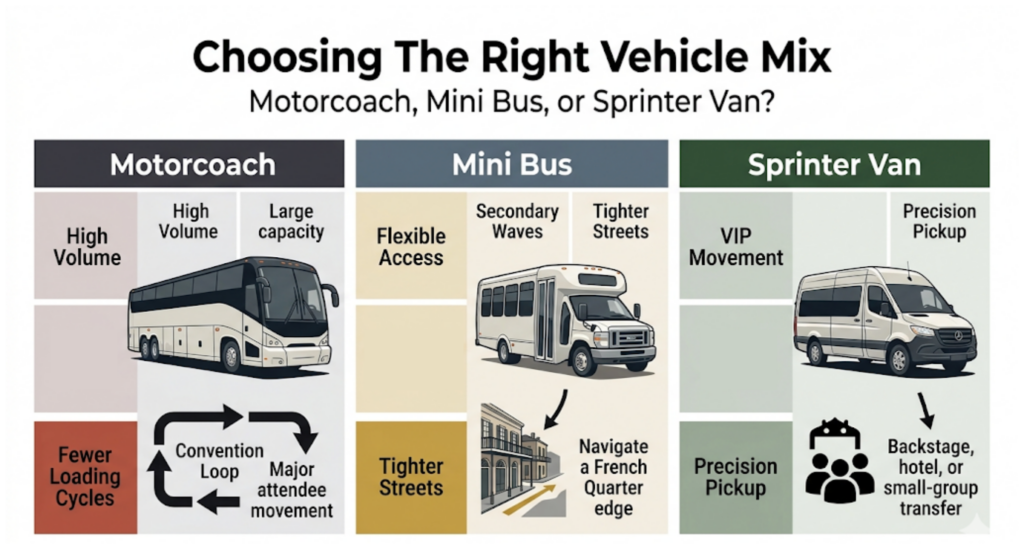
For most large New Orleans events, the right answer is a mixed fleet rather than a single vehicle type. A motorcoach on the main high-volume route, mini buses on tighter access legs and secondary waves, and a sprinter van where group size is small and precision matters — that division of labor fits the actual flow of a large event better than any single vehicle type can.
New Orleans Booking And Operations Checklist
Before event day, the shuttle plan should lock down the items below.
| Planning item | Why it matters in New Orleans |
| Final headcount by route or wave | Large-group movement breaks down quickly when bus assignments are built on rough estimates rather than confirmed numbers. |
| Hotel cluster grouping | CBD, Warehouse District, and edge-of-French-Quarter properties do not behave like one interchangeable pickup zone. |
| Venue loading and unloading plan | The workable curb is often not the one attendees assume, and it may not be available for the return under closure conditions. |
| Staging plan after drop-off | Buses cannot idle at the venue. The staging location needs to be decided before the day begins. |
| Closure and detour assumptions | Parade and festival conditions can invalidate the planned route before attendees start moving. Build the route around closures, not past them. |
| Event-finish dispersal structure | A simultaneous release of several hundred attendees needs a defined pickup zone, a queuing plan, and a communication plan that reaches people before they reach the curb. |
| Multi-bus dispatch logic | Several vehicles running the same program only hold together if riders and ground staff can identify which bus is doing what. |
| Signage and attendee communication | Confusion at pickup compounds with group size. Clear signage and pre-event instructions reduce the load at the moment it is hardest to manage. |
| Accessibility needs | Loading time, stop choice, and route decisions may all shift when accessibility requirements are part of the plan. |
| Contingency plan for route disruption | New Orleans conditions change quickly. The backup route and the backup pickup zone need to be decided before service starts, not during it. |
Conclusion
In New Orleans, large-group shuttle planning is part of how the event operates.
The strongest programs are built around the actual conditions the city creates: closure windows, changing access, tight curb space, and end-of-night crowd release. When hotel loops are clear, staging is decided early, and return service is mapped before the event ends, attendee movement stays orderly and the transportation plan does its job without drawing attention to itself.
FAQs
What makes New Orleans shuttle planning different from other major event cities?
The city itself is an active variable in the transportation plan. Parade closures, festival staging zones, and post-event street conditions can change route access before the first bus moves. Planners who build shuttle programs around a normal street map are already working with assumptions that may not hold. The New Orleans approach requires building the route around what the city’s access conditions will actually be during the event window, not around what they normally are.
When does continuous shuttle service make more sense than scheduled departures?
Continuous service is the right choice when attendees are moving over a long window and the event cannot afford the management overhead of a departure chart. For convention loops, festival movement, and large events where people arrive and leave in repeated waves throughout the day, continuous circulation removes the coordination burden from attendees and keeps the service accessible without requiring anyone to track a schedule.
How should planners handle a parade-route closure that affects the planned pickup zone?
Treat closure timing as an input to the route plan before the event, not a problem to solve after it. Identify when the closure begins to affect the route, where buses can stage before pickup becomes available, and what the attendee walking path looks like from the nearest accessible drop-off point. If the backup pickup zone has not been decided before service starts, it will be decided under pressure with several hundred people already on the street.
What changes when crowd dispersal happens after an event that also had parade or festival conditions?
Everything that made the access conditions complex on the inbound trip may still be present on the outbound. Residual closures, post-event congestion, and reduced curb access can all stack at the same moment the largest number of attendees are trying to leave. That is why dispersal planning for New Orleans events has to account for what the city looks like at departure time, not just at arrival.
How should event-finish returns be structured for a group of several hundred people?
Before the event ends, the pickup zone should be confirmed for the return window, bus queuing should be mapped rather than improvised, and the communication plan should reach attendees while they are still inside. At large scale, a vague return instruction is not the same as a plan. Attendees who are tired and dispersed need a specific location, a clear bus identification system, and instructions that reached them before they were standing on the curb looking for guidance.
When does a mixed fleet of coaches, mini buses, and sprinter vans make more sense than a single vehicle type?
For most large New Orleans events, the answer is almost always a mixed fleet. Coaches are efficient for the main high-volume route where throughput is the priority. Mini buses handle the parts of the program where access is tighter, return waves are smaller, or the route requires more flexibility than a full-size coach can provide. Sprinter vans cover VIP movement, small breakout groups, and access points where even a mini bus is hard to position. The split is not primarily a cost decision; it is about matching vehicle capability to the actual movement conditions at each stage of the event.