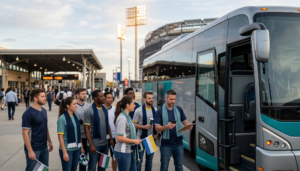


When associations travel to Washington, DC, for programs, they often operate on tight schedules with little margin for error. A Capitol appointment, a timed museum entry, and an evening reception return can all fall inside the same program day, and a late first bus can put every stop after it at risk.
This guide is for association and nonprofit planners managing those realities in Washington. It covers hotel pickups, Capitol and museum timing, multi-stop program-day planning, vehicle choice, and the checklist items that keep transportation from becoming the story of the day. If you are evaluating charter bus service in Washington, DC, the goal here is to help you plan the day well before you book it.
Table of Contents
What Association Transportation Usually Looks Like In Our Washington Booking Data
We have analyzed multiple Washington association and nonprofit bookings, with group sizes ranging from 8 to 132 and a median of 90. Across those bookings, the recurring pattern is a program day built around several timed group movements. Mini buses appear most often, but motorcoaches are required to move most groups larger than 40. The same needs repeat: hotel pickups, Capitol-area appointments, museum and site visits, summit excursions, and evening returns.
Those bookings surface patterns that reflect Washington’s specific demands: hotel-to-Capitol runs from National Mall properties, summit excursions departing from the Marriott Marquis Washington, DC, and multi-stop program days anchored at the AC Hotel. In each case, the task is keeping a tightly sequenced day running on time, not just booking a vehicle from point A to point B.
What These Association Program Days Usually Look Like In Practice
Most Washington association transportation days start from a hotel or hotel cluster and move through several scheduled stops tied to Capitol-area appointments, museums, institutional visits, or summit programming. By end of day, the same plan often absorbs a reception return or final hotel drop.
A Hill day is the most schedule-sensitive version. Delegates may be heading to staggered appointments, departure windows are tight, and a small slip early can affect every stop after it.
A summit or conference excursion is more consolidated. The group starts from one anchor hotel, stays together longer, and needs clean hotel-to-program movement rather than several fragmented runs.
A museum or institutional site visit creates a different problem. The challenge is not just arrival. It is managing timed entry, a legal drop-off, off-site staging for the vehicle, and a coordinated return, without assuming the bus can stay at the curb.
Planning Hotel Pickups For Delegates And Members
Hotel pickups are where Washington transportation days often start to slip.
The first question is whether the group is concentrated in the convention core or distributed across the metro. Those are different planning problems.
If most attendees are in the downtown or convention-core cluster, the challenge is sequencing. Some hotels may be walkable to parts of the program. Others need structured shuttle service. The planner’s job is to group those hotels logically, set the pickup order, and avoid a situation where early riders wait too long while the last stop is still loading.
If the group is split across Washington, Arlington, Bethesda, or National Harbor, it is no longer a downtown pickup plan. It is a routing plan across different operating zones, and it needs to be treated that way from the start.
In our Washington bookings, the Hyatt Place Washington DC/National Mall pattern is the clearest example of a hotel-to-Capitol run. Once the first move of the day is built around a timed destination, the hotel pickup sequence becomes part of the event schedule, not a background detail.
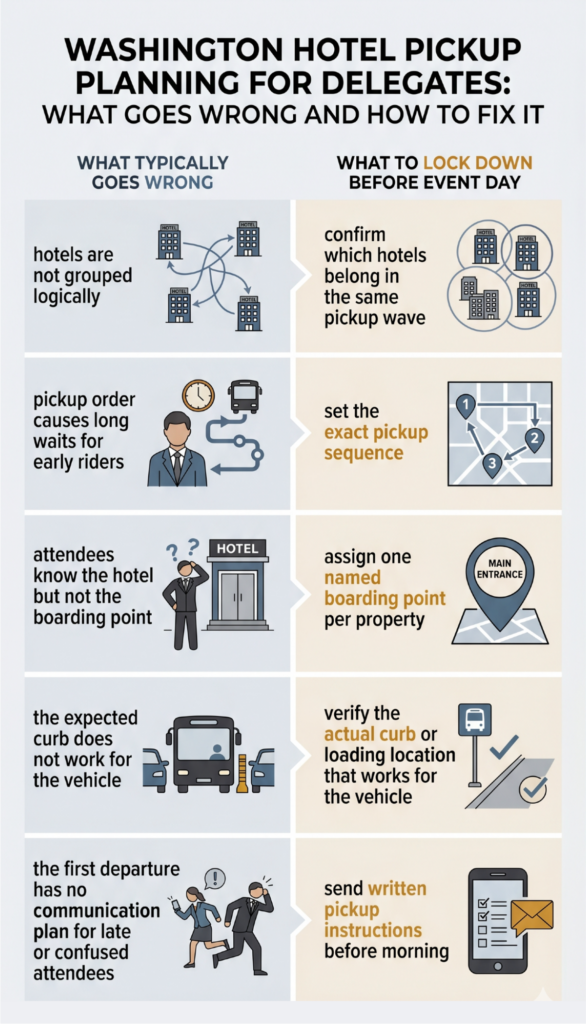
What typically goes wrong at pickup:
- hotels are not grouped logically, adding avoidable route time
- pickup order creates a situation where early boards wait while late hotels are still loading
- attendees are told the hotel name but not the specific boarding point
- the curb the group expects to use is not the curb that works for the vehicle
- the first departure begins without a communication plan for late or confused attendees
The fix is not complicated. Confirm these four things to prevent most of the pickup failures:
- which hotels belong in the same pickup wave
- the exact pickup sequence
- one named boarding point per property
- written attendee instructions delivered before morning
Managing Capitol, Museum, And Site-Visit Timing
Washington stops are harder than standard downtown stops because access is more controlled and timing mistakes carry real consequences.
Capitol-related transportation is not a curbside drop. It is a designated-access problem with timing pressure around arrival, screening, and the next appointment. Build a 20-to-30-minute security buffer into Capitol scheduling. The Capitol Visitor Center’s official accessibility and drop-off guidance uses Garfield Circle as the designated reference point for oversized-vehicle drop-offs, which reinforces the real lesson: these stops are controlled, and the vehicle cannot be treated like a hotel driveway.
Museum and institutional visits require similar discipline. The planner is managing timed entry, one workable drop-off, off-site staging while the group is inside, and a clean return, all of which need to be decided before the day starts.
In Washington, the vehicle often needs a legal place to wait after drop-off rather than circling nearby. Hains Point, Union Station garage, Buzzard’s Point, and RFK Stadium are the kinds of off-site staging options planners and operators work through depending on the route and timing.
The anti-idling rule matters operationally, but the planning lesson is the one that protects the schedule: have the group assembled and ready before the bus is called into position. If the vehicle arrives and attendees are still trickling out, the sequence frays from that point forward.
The museum and garden visit examples in our Washington bookings reflect this clearly. These are not sightseeing add-ons. They are timed, program-level stops that need the same operational discipline as a formal appointment.
Building A Multi-Stop Program-Day Shuttle Plan
A multi-stop day might combine hotel pickups, a Capitol-area appointment, an institutional visit, a museum program, and an evening reception return. On paper, those are separate destinations. In practice, they are one continuous sequence. Treat them as isolated trips and the day becomes hard to recover once one stop moves.
The failures are predictable:
- the first hotel departure runs late
- one pickup point is wrong
- the security buffer is too thin
- the vehicle is not staged where the planner assumed
- the driver is not briefed on the next stop’s access conditions
- one delay spreads through the rest of the schedule
In our own Washington bookings, the AC Hotel multi-stop day captures this most clearly: one bus plan supporting several stops with different timing pressures. The Marriott summit excursion pattern covers the same ground from a more consolidated direction. In both cases, the real work is not choosing a vehicle. It is deciding stop order, time buffers, inter-stop staging, and how the planner communicates when the schedule shifts.
Evening reception returns are the last test of the day’s structure. By the time the reception ends, attendees are tired, the group is less organized, and the pickup discipline that held in the morning can dissolve if no one has been told what happens at the end of the program.
Before the reception ends, lock down:
- the exact pickup zone
- whether the return runs in one wave or several
- how attendees know which bus to board
- what happens if someone misses the first departure window
Choosing The Right Charter Setup For A Washington Program Day
The vehicle decision should follow the structure of the day.
Mini buses appear most often in our Washington bookings for a reason. Many Washington association programs involve moderate group sizes, multiple stops, and loading conditions where flexibility matters more than raw capacity. A minibus fits that reality well.
A motorcoach is the cleaner choice when the group is bigger, the departure is consolidated from one hotel base, or the program holds the full group together across most of the day, as with summit movement where most delegates stay on the same route.
Some programs need a split setup: a larger vehicle for main delegate movement and a smaller one for leadership or a tighter site-visit sequence where access is more restricted.
The right charter setup depends on itinerary shape, stop conditions, and how the group actually moves through the day. Headcount matters, but it is not the whole answer.
Washington Booking And Operations Checklist
Before event day, the transportation plan should lock down the details below.
| Planning item | Why it matters in Washington |
| Confirmed headcount and delegate roster | Vehicle choice and boarding flow only work if the plan matches the real group. |
| Hotel cluster grouping and pickup sequence | This is what keeps departures synchronized instead of staggered across the city. |
| Capitol drop-off plan and security buffer | A timed stop without a real buffer is one of the fastest ways to lose the day. |
| Timed-entry confirmation for museum or site visits | These stops often have less schedule flexibility than planners assume. |
| Staging plan after each drop-off | In Washington, the bus often cannot simply wait nearby. |
| Driver briefing on DC-specific routes and restrictions | The route may be short, but the access logic is not simple. |
| Contingency plan for congressional or program schedule shifts | A small change at one stop can ripple through the rest of the day. |
| Communication plan for delegates at dispersed hotels | Confusion at the first pickup usually grows over the course of the day, not shrinks. |
| Accessibility needs confirmation | This affects boarding time, stop choice, and how the route is executed. |
One resource worth keeping in view: the DDOT Truck and Bus Map. At BusBank, our operators confirm the legal route logic before any day trip begins rather than assuming it.
Off-Program Group Experiences For Washington Association Agendas
If your association agenda includes an evening outing, a leadership add-on, or a structured off-program experience, our partner Viator offers several options in Washington that pair well with planned group transportation. The key is to choose activities that fit the shape of the day, the group size, and the pickup and return discipline your schedule can support.
| Experience | Event type | Who it suits and why it works |
| DC in a Day: 10+ Monuments, Cherry Blossoms, Boat Cruise, Tickets | Full-day sightseeing tour | Works well for larger association groups that want a structured city overview without building a custom itinerary from scratch. It is a strong fit for pre- or post-conference programming, especially when attendees are already staying in central hotel clusters. |
| U.S. Capitol Tour with Library of Congress or Capitol Museum | Civic / institutional experience | Strong option for associations with policy, advocacy, education, or public-sector relevance. This works best for smaller breakout groups or leadership groups because the experience is more access- and timing-sensitive than a broad sightseeing outing. |
| Washington DC Signature Lunch Cruise | Networking lunch / waterfront outing | A good fit for mid-day board, sponsor, or attendee hospitality when the group wants a more social setting without creating a second complicated city-routing problem. It pairs well with one clean transfer in and one clean return out. |
| Washington DC Signature Dinner Cruise | Evening social event | Works well for association dinners, sponsor hosting, or end-of-day group entertainment. This is one of the cleaner options when you want a destination evening activity that still feels organized and easy to brief to attendees. |
| Private Guided Tour of Washington DC | Private group outing | Useful when the association wants a more controlled, customizable experience for a private delegation. For leadership teams or curated attendee tracks, this is often the cleaner option because the experience can be shaped around the group rather than the other way around. |
For association planners, the best add-on experiences are the ones that do not create a second transportation problem. If the outing is time-sensitive, spread across different pickup points, or likely to end in waves, treat it with the same planning discipline as the main program day.
Conclusion
Washington association transportation works best when the planner treats it as part of the program, not a vendor line item to fill in at the end.
The strongest plan protects attendance, schedule integrity, and the member experience across the full day. That means thinking carefully about hotel sequencing, timed-stop buffers, staging logic, and return discipline, because the map alone will suggest the day is simpler than it is.
When the plan holds together, transportation becomes invisible. Attendees arrive on time, the program runs as scheduled, and no one is writing the post-event recap about the buses. In Washington, that counts as a win.
FAQs
How early should associations schedule hotel departures for Capitol appointments?
Plan for more buffer than the drive time suggests. In Washington, the departure needs to absorb hotel pickup flow, curb access at the drop-off point, and a 20-to-30-minute security buffer after arrival, not just the traffic. For a 9:30 appointment at the Capitol Visitor Center, many planners work backward from a 9:00 arrival and build pickup and departure times from there.
When does a minibus make more sense than a motorcoach in Washington?
A minibus is often the better fit when the group is moderate in size, the day includes several stops with different access conditions, and the program needs flexibility over capacity. A motorcoach makes more sense when the full group is moving together on a consolidated route, such as a summit departure from one hotel, where the larger vehicle’s efficiency and comfort justify the access tradeoffs.
Where do charter buses wait after dropping off at museums or federal sites?
Usually not at the curb. In Washington, the vehicle typically needs an off-site staging plan after drop-off. Hains Point, Union Station garage, Buzzard’s Point, and RFK Stadium are examples of the kinds of options operators work through depending on the stop, the route, and how long the group will be inside.
How should planners handle attendees staying at several hotels?
Treat it as a sequencing problem. Group the hotels logically by proximity and travel direction, confirm the pickup order, name one specific boarding point per property, and distribute those instructions to attendees before the morning begins. The more dispersed the hotel geography, particularly if it crosses into Arlington, Bethesda, or National Harbor, the more important it is to treat this as a routing decision, not just a pickup list.
What changes when the program includes multiple timed stops?
Every stop becomes a schedule-control problem. Buffer time, inter-stop staging, and driver briefing matter more because one delay at any stop can spread through everything after it. The strongest multi-stop plans treat the vehicle as part of the event infrastructure, with the same operational discipline applied to each stop that you would apply to the program itself.
How should evening reception returns be planned in Washington?
Before the reception ends, the planner should have confirmed the exact pickup zone, decided whether the return runs in one wave or several, and communicated that plan to attendees. The return is often harder than the outbound trip: the group is less organized, rideshares spike at the same time, and the curb that was available in the morning may not be available at 9 p.m.