

When planning corporate transportation in Nashville, the hard part usually is not finding a vehicle. It is getting a group from the airport to the right hotel, from the hotel to the right venue, and back again without late arrivals, mixed-up pickup points, or a string of rideshare problems at the end of the night. The complexity builds quickly once 15 or more attendees need to arrive and leave on one schedule.
Nashville adds a few complications that make this harder than it looks on paper. Conference hotels can be clustered downtown or closer to Gaylord Opryland. BNA is close enough to downtown to look simple, but flight timing, luggage, and traffic can still throw the day off. Then there is the downtown piece. Dinner shuttles, event-night returns, and Broadway-area congestion can turn a short move into a coordination problem if the transportation plan is loose.
This guide is built for planners who are already dealing with that reality. It covers hotel pickups, downtown and event-night transportation, BNA arrivals and departures, and how to choose the right service setup for conference, off-site, and loop transportation in Nashville.
Table of Contents
What BusBank’s Nashville Booking Data Shows
BusBank’s 2025 Nashville corporate bookings show a recurring pattern of group movement between hotels, downtown venues, BNA, and event locations. Across those bookings, group sizes ranged from 52 to 224 passengers, with a median group size of 129.
The clearest demand areas are conference hotel pickups, downtown dinner and event-night transportation, BNA arrivals and departures, convention-center and off-site transfers, and loop service between hotels and activity areas.
Why Nashville Needs A Tighter Transportation Plan
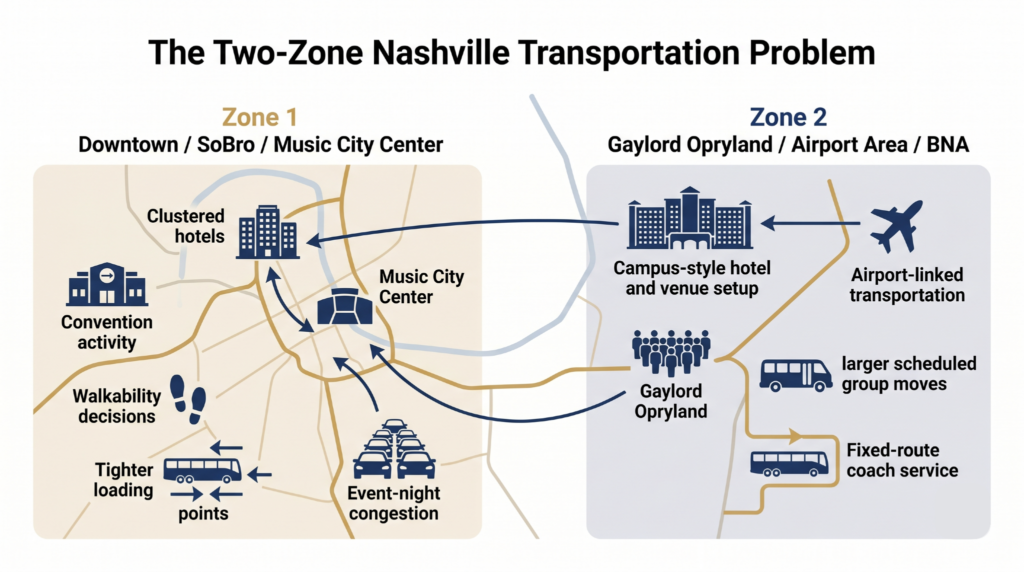
One reason Nashville trips get messy is that planners are often working across two different operating zones.
The first is the downtown and SoBro cluster around Music City Center. This is where curb access, hotel loading, walkability, and event-night congestion matter most. The second is the Gaylord Opryland and airport-area zone, which behaves more like a campus-and-transfer problem. The distances are different. The routing is different. The best vehicle setup can be different too.
If a group is moving between those zones, the planner has to think about pickup windows, loading points, traffic, and whether one service setup can realistically cover the whole day.
When A Charter Bus Usually Makes Sense In Nashville
The clearest use cases tend to fall into five buckets:
- conference hotel pickups and attendee arrivals
- downtown dinner and event-night transportation
- BNA arrivals and departures
- convention-center and off-site transfers
- loop service between hotels and activity areas
In our Nashville corporate bookings, one customer needed transportation from Conrad Nashville to Puttshack and then multiple departures to BNA. Another asked for hotel-to-dinner transportation and was openly weighing whether smaller shuttles would be more economical. A separate booking used loop service between a hotel and downtown for about 200 attendees over the course of an evening.
That is the core pattern in Nashville. Planners are usually coordinating a group across several movements on one schedule, which is where a charter bus becomes useful.
Planning Hotel Pickups Without Losing The Group
Hotel pickups are where a lot of corporate transportation days start to slide. On paper, the route may look short. In practice, the problems show up earlier:
- attendees are spread across several hotels
- the pickup order is not grouped by zone
- the boarding instructions are vague
- luggage takes longer than expected
- some guests are waiting in the wrong place
In Nashville, the first useful distinction is whether the hotel block is largely walkable to Music City Center or whether it needs structured shuttle service. Not every downtown hotel needs a bus in the same way. Some groups can reasonably walk part of the schedule. Others cannot, especially if timing is tight, weather is bad, the group is large, or the itinerary includes luggage or evening return service.
The better approach is to think in clusters, not individual addresses. Decide which hotels belong in the same pickup wave, confirm the order, and make sure attendees know exactly where to wait. That sounds basic, but it is usually where staggered arrivals begin.
It is also worth being specific about what a pickup point means in Nashville. Downtown hotel loading is not always the front lobby curb. In practice, it may mean a side entrance, a valet lane, or a designated avenue that works better for group boarding.
If the group is staying across both downtown and Gaylord or airport-area properties, that should be treated as a routing decision from the start, not as a last-minute adjustment.
Gaylord Opryland, Convention Transfers, And Off-Site Moves
Gaylord Opryland and the airport-area hotel zone need their own planning logic. This is not the same problem as loading outside a downtown hotel and heading a few minutes across SoBro. These trips are more likely to involve larger groups, fixed departure times, and a clearer need for scheduled coach service.
In our bookings, this zone shows up in more than one way. One group needed a transfer from Gaylord Opryland Convention Center to Whisky Row for an evening event. Another needed transportation that stayed useful across a full day with property tours and a conference-space drop-off.
Airport-area hotel stays can create the same kind of fixed-route, scheduled-departure pattern, especially when the group is moving as a block between lodging, conference space, and BNA.
That is where vehicle choice starts to matter. If the group is leaving together for a convention session, an evening event, or an airport departure, a larger coach is usually the cleaner fit because everyone boards once and moves on one schedule. If the itinerary breaks into smaller attendee waves or shorter off-site runs, a smaller shuttle may be easier to manage. Some planners end up needing both: a larger coach for the main move and a smaller vehicle for secondary runs.
The right vehicle depends on the structure of the day, not just the headcount.
Downtown And Event-Night Transportation
Downtown Nashville looks simple until the return trip starts.
Dinner shuttles, client events, and Broadway-adjacent evening movements often create the most avoidable friction in the whole itinerary. The issue usually is not the outbound trip. It is the part where some guests leave early, others stay later, pickup points are crowded, and the planner is trying to avoid ending the night with a string of texts asking where the bus is.
This is why event-night return logistics deserve their own planning conversation. Before the group leaves the hotel, the planner should already have:
- a confirmed pickup window
- one clearly named meeting point
- instructions for attendees who drift off after dinner or an event
- a communication plan for anyone who misses the first wave
Broadway and adjacent areas can become especially difficult on Friday and Saturday nights, so vague pickup plans are expensive here. A route that looked fine at noon can feel very different later in the evening.
Downtown curb space is also getting more tightly managed. Nashville’s smart loading zone pilot includes strict time limits and peak pricing in parts of the core, which means “the bus can just wait there” is not a safe assumption. For corporate planners, that makes the pickup window, loading location, and attendee instructions more important than they might seem on paper.
This is also where vehicle fit matters. For tighter dinner routes or smaller return waves, a mini bus may be the cleaner option than a full coach.
Handling BNA Arrivals And Departures
BNA is close enough to downtown that planners sometimes underestimate the coordination required.
The airport is about 8 miles from downtown Nashville. Under normal conditions, the trip often takes around 15 to 25 minutes. During rush hour or event congestion, it can take longer, and that is before you add baggage, staggered arrivals, or a large group that needs to board together.
For airport pickups and departures, the details matter:
- Arrival windows
- Luggage volume
- Whether the group is landing together or in waves
- Whether the same vehicle is continuing into a hotel or event transfer
- How much buffer the planner has before the next scheduled movement
The BNA Ground Transportation Center is on Level 1 of Terminal Garage 2. It also helps to know that airport access is not casual for professional operators. Nashville International Airport requires operators that access the airport more than twice a month to hold an MNAA permit, and vehicles must be tagged before they begin operating there. These kinds of details matter because airport confusion tends to multiply when the group is large and already tired.
One of our booking requests included multiple BNA departures from the same hotel on the same morning. That is a good example of why airport transportation is not just a quick add-on. It can be one of the most time-sensitive parts of the trip. For planners, the takeaway is simple: airport transportation should be handled by an operator that already knows the BNA process and is set up to work inside it.
Airport transportation is also one of the clearest cases for larger coaches. When the group is large, the departure is synchronized, and luggage is involved, bigger vehicles usually create less friction.
Quick Planning Table For Common Nashville Group Moves
| Use case | What usually works best | Why it tends to work |
| Hotel pickups to downtown meetings, dinners, or Music City Center | Scheduled shuttle or coach service with grouped pickup windows | It keeps attendees moving on one timetable instead of creating staggered arrivals from multiple hotels. |
| Gaylord Opryland or airport-area conference transfers | Dedicated coach service or a fixed shuttle loop | These moves are usually more structured and work best when the transportation follows a clear schedule. |
| BNA arrivals or departures with luggage | Larger coach service, especially for synchronized group movement | Luggage, flight timing, and one shared departure window create more friction when the group is split across cars. |
| Downtown event-night returns | Smaller shuttles, minibuses, or loop service depending on the group pattern | Return times tend to spread out, pickup points can get messy, and a flexible setup is easier to manage. |
| Multi-stop off-sites or property-tour days | Full-day service | Once the day includes several stops, the vehicle needs to stay with the group instead of operating as a simple transfer. |
| Groups moving in waves between a hotel base and downtown | Loop service | It handles staggered movement better than trying to force everyone into one departure and one return. |
Choosing Between One-Way, Loop, And Full-Day Service
This is one of the places where planners save themselves trouble by deciding early.
A one-way transfer works when the job is simple and the schedule is firm. A roundtrip works when the group is moving out and back on a predictable timetable. Loop service makes sense when people are moving in waves between the same few points. Full-day service makes sense when the planner knows the itinerary has several stops or the return time is likely to move.
In our booking data, loop service comes up when groups are moving between a hotel base and downtown over several hours rather than one fixed departure and one fixed return. Full-day service shows up when the day includes property tours, conference-related movement, or several planned stops. Even the Conrad Nashville, Puttshack, and BNA example points to a day that works better as coordinated service than as isolated transfers.
If a group is arriving at different times, heading to dinner later, and returning to several hotels, the cleanest plan may not be one vehicle on one route. A mixed setup can be the better answer.
Charter Bus Vs. Rideshares For Large Corporate Groups
Corporate planners often compare charter buses and rideshares, so it makes sense to answer that question directly. Rideshares start to break down when the success of the event depends on the group arriving together. That is especially true when:
- The group is large
- The pickup is from several hotels
- The destination has timing pressure
- The return happens late at night
- Airport luggage is involved
Cost matters, but control is usually the bigger issue. Once the group is split across multiple cars, the planner loses one arrival window, one communication chain, and one clean handoff. A few late cars can turn a simple schedule into a rolling delay.
That is where a charter bus usually becomes easier to defend. One boarding plan. One group arrival. One return process.
Our bookings ranged from 52 to 224 passengers. Once a group is operating even near the lower end of that range, the logistics of splitting everyone across rideshares begins to work against the planner.
Nashville Booking And Operations Checklist
Before event day, the transportation plan should at a minimum lock down the following:
| Planning item | Why it matters |
| Booking lead time | It affects vehicle availability, routing flexibility, and how many workable options the planner still has. |
| Final headcount | The transportation plan only works if the vehicles match the actual group size. |
| Hotel cluster grouping by zone | It prevents inefficient crisscrossing and helps keep pickups on a realistic schedule. |
| Confirmed pickup sequence | The order of stops affects arrival timing, loading pressure, and how long the first riders stay on board. |
| Airport arrival and departure schedule | BNA moves fall apart quickly when flight times are not grouped and buffered properly. |
| Luggage assumptions | Luggage changes how much space the group needs and which vehicle setup makes sense. |
| Vehicle sizing | The right vehicle depends on both headcount and the structure of the day. |
| Operator contact and day-of communication plan | When timing shifts, the planner needs one clear communication path instead of a scramble. |
| Event-night return instructions | Late-night returns get messy when attendees do not know where to board or when service resumes. |
| Contingency plan for delays or itinerary changes | A backup plan keeps one schedule slip from turning into a broader operational problem. |
This is also the place to confirm which parts of the schedule are fixed and which parts may move. If a planner knows the return from dinner is flexible, or the airport departures are stacked tightly, that should be part of the transportation conversation before the day starts, not during it.
Corporate-Friendly Nashville Outing Ideas To Pair With Group Transportation
BusBank partners with Viator to make it easier for planners to book Nashville activities alongside group transportation. If the group itinerary includes an evening program or off-site outing, the table below covers options that tend to work well with scheduled group arrivals and one coordinated return window.
| Event | Event type | Suitable for / why it works |
| Grand Ole Opry Show | Live music / evening entertainment | Strong fit for hosted evening entertainment after meetings or conference sessions. It is easier to pair with scheduled arrivals and one coordinated return window. |
| General Jackson Showboat Lunch or Dinner Cruise | Dinner cruise / client entertainment | A good option for group dinners, hosted client nights, or conference-side entertainment. The fixed departure structure makes transportation planning more straightforward. |
| Country Music Hall of Fame + Museum | Museum / cultural off-site | Useful for a shorter off-site block, spouse program, or cultural add-on near downtown. It pairs well with hotel pickups or a downtown shuttle plan instead of fragmented rides. |
| Nashville Evening Trolley Tour | Guided sightseeing / evening outing | A workable option when the group wants a lighter evening activity without splitting into multiple cars. It is useful for planners who want one boarding point and one shared return. |
| Nashville: Food Tour with Tastings of Local Delicacies | Food tour / neighborhood experience | Better suited to smaller executive groups, hosted client outings, or leadership dinners. It needs tighter timing and group-size screening before it is added to a larger event schedule. |
Activities with fixed departure and return structures are generally easier to build transportation around. When the activity timing is predictable, the pickup and drop-off plan can be set in advance rather than adjusted on the night.
Conclusion
Corporate transportation in Nashville usually goes wrong in predictable ways. The group is split across hotels. The airport timing is too tight. The dinner return is underplanned. The route looks easy until downtown fills up.
The upside is that these are planning problems, which means they are fixable.
The trips in our Nashville data point to the same lesson over and over: the best transportation plan is the one that treats the day as a sequence of group movements, not a string of isolated rides. When hotel pickups are grouped correctly, airport timing is realistic, and the return plan is clear, the rest of the event gets easier to run.
If you are building that plan now, our team can help structure the routing, match the vehicle to the itinerary, and tighten the day-of coordination before the schedule starts to slip.
FAQs
How far is BNA from downtown Nashville for a corporate group transfer?
BNA is about 8 miles from downtown Nashville. Under normal conditions, the drive is often around 15 to 25 minutes, but planners should allow more time during rush hour or event congestion.
Do all downtown Nashville conference hotels need shuttle service?
No. Some downtown hotels are walkable to Music City Center, while others are better handled with structured shuttle service. The decision depends on distance, group size, timing, weather, and whether luggage or evening returns are part of the schedule.
How is Gaylord Opryland transportation planning different from downtown Nashville transportation?
Gaylord and the airport-area zone usually work more like scheduled campus-and-transfer movements. Downtown planning is more curb-sensitive and often involves tighter loading points, walkability decisions, and more event-night congestion.
When does loop service make sense for a Nashville corporate event?
Loop service makes sense when attendees are moving in waves between the same points, such as hotels and a downtown event area, or when the return window is spread across a few hours instead of one fixed time.
Is a charter bus better than rideshares for large corporate groups in Nashville?
Usually, yes, once the planner needs the group to stay together on one schedule. The bigger the group and the more complex the itinerary, the less practical fragmented rideshares become.
How early should planners schedule airport departures from downtown hotels?
Start with more than the drive time alone suggests. The downtown-to-BNA trip often takes around 15 to 25 minutes under normal conditions, but with a large group, luggage loading, and city traffic, a 45-to-60-minute buffer before check-in cutoff is a reasonable starting point. Add more time during peak convention periods or the morning rush.