


Most Orlando group transportation problems start the same way: a schedule that looks simple and a map that looks manageable. Three off-property hotels, a Disney World day, an event night at Epcot or Disney Springs, and a late return. The distance between any two stops is short. The coordination problem is not.
This guide is for group planners managing that kind of day. It covers off-property hotel pickups, Disney-day timing and park-close returns, Epcot and Disney Springs event nights, MCO-linked arrivals, and the vehicle and service decisions that keep a full Orlando day from coming apart at the end. If you are evaluating charter bus service in Orlando, the goal here is to help you build the day correctly before you book it.
Table of Contents
What Orlando Group Transportation Usually Looks Like In Our Booking Data
We have analyzed multiple Orlando bookings from 2025 across corporate, academic, nonprofit, and social groups. Group sizes range from 16 to 728, with a median around 75. Mini buses appear most often, followed by deluxe motorcoaches.
Those bookings reflect the full range of Orlando group movement: multiple Disney park drops, Epcot-linked conference transportation, hotel-to-dinner returns, and airport arrivals that feed directly into the day’s first move. In each case, the planning challenge is the same: keeping a spread-out group on one schedule from the first hotel pickup through the last return of the night.
When Groups Usually Need A Charter Bus In Orlando
A charter bus makes sense when the group needs to move on one schedule rather than scatter across hotel shuttles, rideshares, or Disney’s internal resort transportation.
In Orlando, that usually shows up in these forms:
| Use Case | Key Issue | Why It Matters |
| Off-property hotel to Disney World | Unified arrival | A group split across hotel shuttles almost never arrives together, and fragmented arrivals make the park day harder to manage from the start. |
| Park-close returns | Controlled pickup | Attendees are tired, exit crowds are heavy, and no one is certain exactly when the last person is ready to leave. |
| Conference off-sites at Epcot or Disney venues | Schedule alignment | These groups have tighter arrival windows than a leisure day and less tolerance for fragmented movement. |
| Epcot event nights | Defined return window | A structured outbound move is manageable. The late-night return is where the plan earns its value. |
| Disney Springs dinners and receptions | Return discipline | Disney Springs is open-ended, and dispersed departures make the ride home the hardest part to manage. |
| MCO arrivals and departures | Luggage and staggered timing | Airport days compress the schedule in ways that only become visible once the group is already in motion. |
Once the planner needs the group to arrive together, board from one known place, and return without confusion at the end of the day, the transportation plan has to be structured rather than improvised.
Planning Hotel Pickups For Off-Property Groups
Off-property pickups set the tone for the rest of the day. In Orlando, hotel geography changes the transportation plan more than many planners expect.
Lake Buena Vista is usually the cleaner starting point for Disney-focused movement. Hotels in that corridor are closer to the parks, and morning departure math is more forgiving.
International Drive and the OCCC corridor are more conference-oriented, which often means longer transfers to the parks or to evening events. Kissimmee can work well for budget-conscious groups, but it changes the morning departure timeline and makes late-night returns less forgiving.
The on-property versus off-property distinction also matters. Disney’s internal transportation system helps resort guests move within the Disney ecosystem. It is not designed to move 50, 75, or 150 off-property attendees on one coordinated schedule.
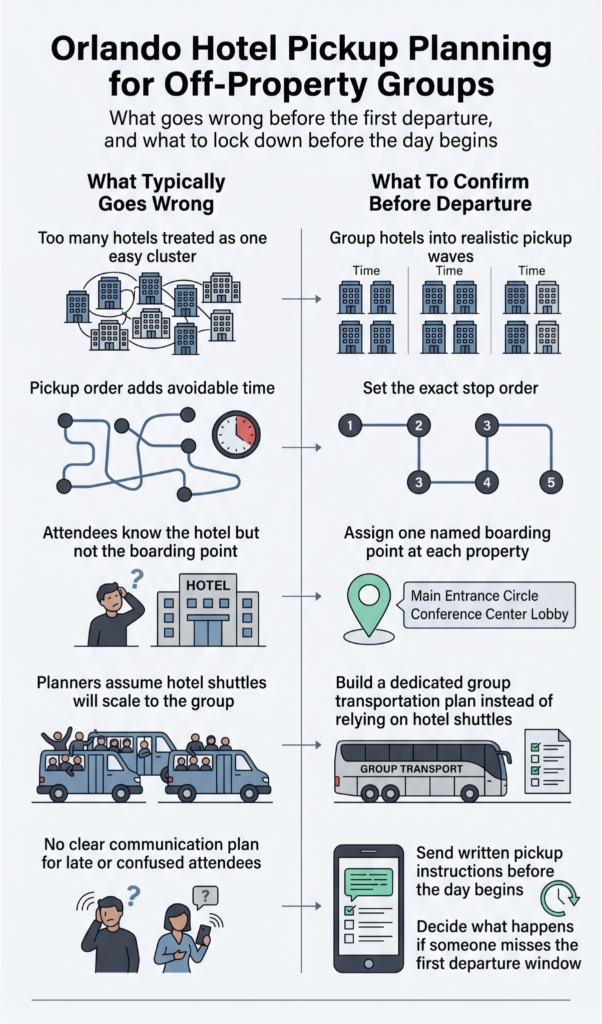
What typically goes wrong at pickup:
- too many hotels are treated as one easy cluster when they are spread across different zones
- the pickup order adds avoidable time before the group is fully loaded
- attendees know the hotel name but not the exact boarding point
- planners assume the hotel shuttle setup will scale to a large group
- the first departure starts without a clear communication plan for late or confused attendees
The fix is not complicated. Confirm these things before the day begins:
- which hotels belong in the same pickup wave
- the exact stop order
- one named boarding point at each property
- written pickup instructions sent to attendees the night before
- a clear plan for what happens if someone misses the first departure window
If the first hotel wave leaves cleanly, the rest of the day has a chance to hold. If it starts late, that pressure carries through every stop after it.
Managing Disney World Day Transportation Without Losing The Group
Disney World day transportation is an arrival-and-return problem, not just a route problem.
For off-property groups, the outbound move has to do two things at once: get the group there on time and get them there together. That is why a private charter setup is usually chosen over hotel shuttles or rideshares, not because the drive is complicated, but because unified arrival is the entire point of the plan.
The arrival routing is worth understanding before the schedule is built. Disney’s park bus hours are useful context here because they show how tightly park transportation is built around opening and closing windows. For Magic Kingdom specifically, off-property charter buses do not drive directly to the park entrance. The standard route runs through the Transportation and Ticket Center, which adds a transfer step that does not appear in a standard driving estimate. A departure built around drive time alone will not account for that extra step. A group that arrives five minutes before their planned opening window has already lost the buffer it needed.
Planners should also know that Disney World charges an oversized vehicle parking fee for buses and coaches. Verify the current amount against Disney’s website when building the budget, but factor it into the plan regardless of the exact number.
In our Orlando bookings, Disney-day transportation appears in more than one form. Some groups are moving directly to one or more parks. Others are building a Disney stop into a larger conference or event itinerary. The planning question stays the same: how much structure does the day need to keep the group intact?
The return leg is where that question becomes urgent. At park close, attendees are tired, exit waves are uneven, rideshare demand spikes across the entire resort at the same time, and the pickup discipline that held in the morning can disappear quickly if no one knows where to go or when the bus is leaving. Park-close returns need a specific pickup zone, a clear return window communicated before the last hour of the day, and a communication plan that reaches attendees while they are still inside, not as they are walking out the gates.
Epcot Event Nights Are Not The Same As Disney Springs Returns
Both belong in this article, but they are different transportation problems and should be planned differently.
An Epcot event night is more structured. The group usually has a defined arrival window, a clear event purpose, and a more predictable return time. That structure makes it possible to build one coordinated outbound move and one planned late-night pickup. In our Orlando bookings, Epcot movement appears in conference and event-linked contexts where schedule alignment is already part of the brief. The main planning risk is assuming the structure of the event makes the return easy by default. It helps, but attendees still need to know exactly where to be and when.
A Disney Springs night is looser. Dinner, social time, and open-ended movement mean the group is likely to fragment, and staggered departures are the default rather than the exception. The outbound move is usually straightforward. The return is where it gets harder, especially when the group is spread across several hotels and attendees start leaving in small groups rather than as a whole.
For both use cases, the same questions need to be answered before the evening starts:
- what is the exact pickup point
- is the return in one wave or several
- how will attendees know which vehicle to board
- what happens if someone misses the first departure
The longer the Orlando day runs, the more valuable those answers are. Planners who leave return logistics to the end of the evening are the ones writing apology emails the following morning.
MCO Arrivals And Departures Need Their Own Transportation Plan
Airport-linked movement changes the rest of the itinerary even when the airport is not the main event.
The MCO-to-Disney-area transfer runs roughly 25 to 35 minutes under normal conditions. That number looks comfortable on paper. In practice, same-day airport, hotel check-in, and Disney or event movement compress quickly once luggage is involved, arrivals are staggered, and the gap between landing and the first scheduled activity is shorter than it appeared at the planning stage.
Three things planners regularly underestimate on airport days:
- Luggage changes vehicle fit. A group whose headcount fits a minibus may need a larger vehicle once bags are in the equation.
- Staggered arrivals change the departure plan. If the group is coming in on different flights, a single pickup time forces a choice between leaving early arrivals waiting or running the bus before everyone has landed.
- Same-day sequencing leaves no recovery time. An airport move that feeds into hotel check-in that feeds into a park visit has no slack. One slow baggage claim or one delayed flight changes the shape of the afternoon.
In our Orlando bookings, airport-linked transportation appears as part of broader itineraries rather than standalone transfers. That is the right way to treat it. Once the MCO leg is tied to the same day as a park visit or an evening event, it is not an airport transfer. It is the first move of a longer plan, and it should be treated accordingly.
Choosing The Right Service Model For An Orlando Group Day
The right service model depends on the structure of the day more than the distance of the route.
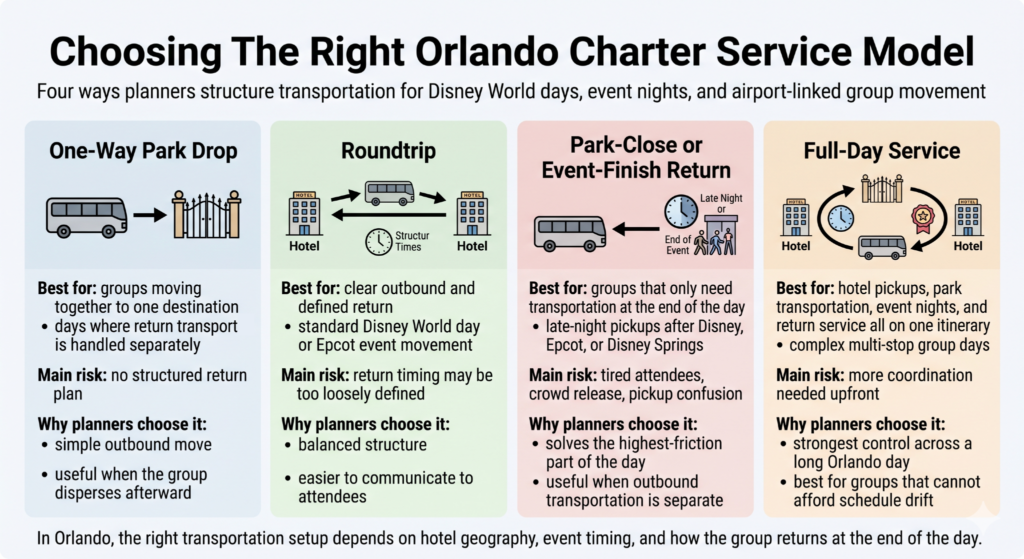
Four service structures cover most Orlando group needs:
- One-way park drop: works when the group is moving together to one destination and the return is handled separately or on individual schedules. Useful for arrivals where the group disperses for the rest of the day.
- Roundtrip: works when the day has a clear outbound and a defined endpoint. Most Disney day and Epcot event bookings fall here.
- Park-close or event-finish return: the vehicle is not needed for the outbound leg, only for the return after a long day. This is the highest-risk service window in Orlando because the group is most tired and least organized at exactly the moment the transportation needs to work cleanly.
- Full-day service: the vehicle stays with the group across multiple moves. The right call when the itinerary includes hotel pickups, a park, an event, and a return all on the same day and the day cannot afford a gap in coverage.
Mini buses appear most often in our Orlando bookings for practical reasons. Many Orlando groups fall in the small-to-mid-size range, and segmented hotel pickups, flexible routing, and tighter loading conditions at off-property hotels favor a more nimble vehicle. A minibus that can pull up to a hotel driveway on a Kissimmee side street is often a cleaner fit for that kind of morning than a full-size coach.
A motorcoach is the right choice when the movement is more consolidated: one coordinated departure from a single hotel cluster, a large conference or event group, or luggage-heavy airport movement where storage capacity matters as much as headcount.
The vehicle should follow the itinerary. Headcount matters, but the shape of the day matters more.
Orlando Booking And Operations Checklist
Before the day starts, the transportation plan should lock down the details below.
| Planning item | Why it matters in Orlando |
| Final headcount and rooming pattern | This affects vehicle choice, hotel grouping, and whether the group can realistically move in one wave. |
| Hotel cluster grouping | Lake Buena Vista, International Drive, and Kissimmee create different pickup timelines and route lengths. |
| Exact pickup order | Early inefficiency at the hotels carries through the rest of the day. |
| Named boarding point at each hotel | Orlando hotel properties can be larger and less obvious than attendees expect. |
| Disney-day arrival target | Park days work better when the departure is built around a realistic arrival window, not a best-case drive time. |
| Return plan for Epcot or Disney Springs | Evening returns become harder once attendees disperse and fatigue sets in. |
| MCO integration and luggage assumptions | Airport-linked transportation changes both timing and vehicle fit in ways headcount alone does not capture. |
| Vehicle type and service model | One-way, roundtrip, park-close, and full-day service solve different problems. Match the model to the itinerary. |
| Attendee communication plan | If riders do not know where to board or when to return, the transportation plan starts failing before the bus moves. |
| Contingency plan for late-night delays | Orlando traffic, park-close crowd patterns, and tired attendees can all stretch the last movement of the day. |
Orlando Add-Ons That Work Better With A Transportation Plan
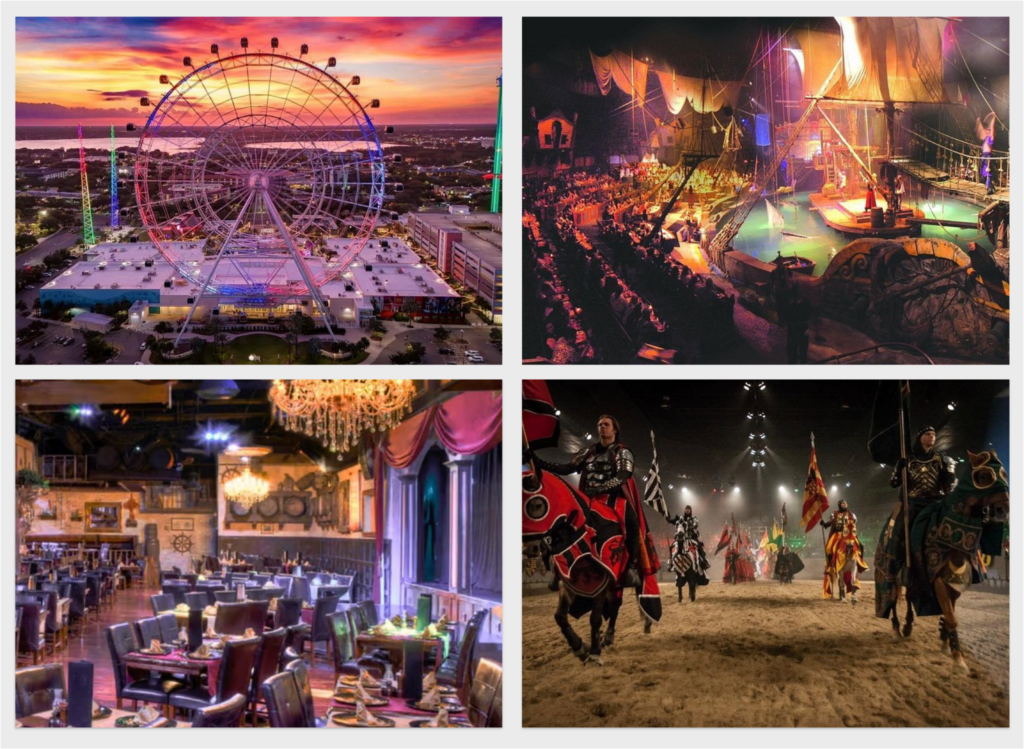
Once the Disney day is planned and the event nights are mapped out, the next question is what to do with the free time in between. Orlando has no shortage of options, which is part of the problem. Our partner Viator has several Orlando experiences that work well for groups, but the ones worth building into the plan are those that fit cleanly into an existing transportation structure rather than creating a new one from scratch.
| Experience | Best Paired With | Transportation Fit |
| Kennedy Space Center Day Trip from Orlando | Conference or incentive off-day | One clean departure, one clean return. The schedule is defined and the end time is predictable, which makes pickup straightforward and the day easy to brief to attendees. |
| Madame Tussauds, Orlando Eye, and SEA LIFE Aquarium at ICON Park | I-Drive groups with a lighter evening | The compact footprint keeps the return simple. For groups already based on International Drive, this is one of the lower-friction add-ons because proximity reduces the transportation problem considerably. |
| Speakeasy Murder Mystery Dinner Show | Team dinners or smaller conference groups | One venue, one arrival window, one return wave. The fixed format is the main transportation advantage over an open-ended night spread across several restaurants or districts. |
| Pirates Dinner Adventure | Groups wanting a curated evening format | A defined showtime and fixed venue support a cleaner return plan than an open-ended night on International Drive. This works well when the planner wants the evening to feel more produced and less dispersed. |
| Everglades Airboat Tour from Orlando | Leadership tracks or smaller breakout groups | Shorter duration makes it easier to slot into a half-day before or after a main program event. Works best for smaller groups where the return is a single, manageable wave rather than a large-scale pickup. |
In Orlando, the experience options are unusually broad, which makes the choice harder than it looks. Theme parks, dinner shows, nature tours, and entertainment districts can all appear on the same shortlist. The ones that hold up best in a structured group context are those with a defined start, a predictable end, and a pickup zone that does not require reinventing the transportation plan you already built.
Conclusion
Orlando group transportation works best when the planner treats it as one continuous plan rather than a set of separate rides stitched together on the day.
The strongest plans are built backward from the return. Not because the return is the first thing to book, but because it is where most Orlando group days fail. When the hotel pickups are sequenced well, the Disney-day buffer is realistic, the evening return has a clear pickup point and a communication plan, and the airport leg is treated as the first move of a longer schedule rather than a quick transfer, the day tends to hold together.
When those decisions are made early, the group arrives together, the event starts on time, and the return does not become the part everyone remembers for the wrong reason.
FAQs
How early should off-property groups leave for Disney World?
Earlier than the drive time alone suggests. Off-property groups need to build in time for hotel loading, pickup sequencing, and Orlando traffic, plus any additional arrival steps that some Disney park entries require beyond a standard drive-to-gate drop. For Magic Kingdom specifically, the route through the Transportation and Ticket Center adds time that a standard GPS estimate will not show. Plan for the realistic arrival window, not the optimistic one.
Are hotel shuttles enough for large groups going to Disney World?
Usually not if the group needs to arrive together on a fixed schedule. Hotel shuttles are designed for individual travelers and run on their own timing. For a group that needs a coordinated departure, a specific arrival window, and a planned return, a dedicated charter setup gives the planner control that shared hotel shuttles cannot provide.
What changes when the group is staying on International Drive instead of near Disney?
The route gets longer and morning departure math becomes less forgiving. International Drive is well-positioned for convention and conference groups, but it adds transfer time for Disney days and makes late-night returns more complicated compared to a Lake Buena Vista starting point. Planners working from I-Drive should build extra buffer into both the morning departure and the evening return.
When does a minibus make more sense than a motorcoach in Orlando?
A minibus is often the better fit when the group is moderate in size and the itinerary requires flexibility across multiple hotel pickups, segmented returns, or tighter loading conditions at off-property hotels. A motorcoach makes more sense when the group is larger, the movement is more consolidated from a single departure point, or luggage is a significant part of the plan and storage capacity matters.
How should planners handle late-night returns from Epcot or Disney Springs?
Decide the pickup point, return window, and boarding instructions before the evening begins, not at the end of it. For Epcot, where the event structure is more defined, the return is usually more manageable if it is communicated early. For Disney Springs, where movement is more open-ended, the return needs more active coordination because attendees are more likely to drift and depart in smaller groups rather than as a whole.
How should MCO arrivals be integrated into a Disney-day itinerary?
Conservatively. If the airport transfer, hotel check-in, and Disney transportation all fall on the same day, the plan needs extra buffer for luggage, staggered arrivals, and the time needed to regroup before the next move. Treat the MCO leg as the first piece of a longer operating plan rather than a standalone transfer, and build the rest of the day’s timing from a realistic read of how long that first move actually takes.