

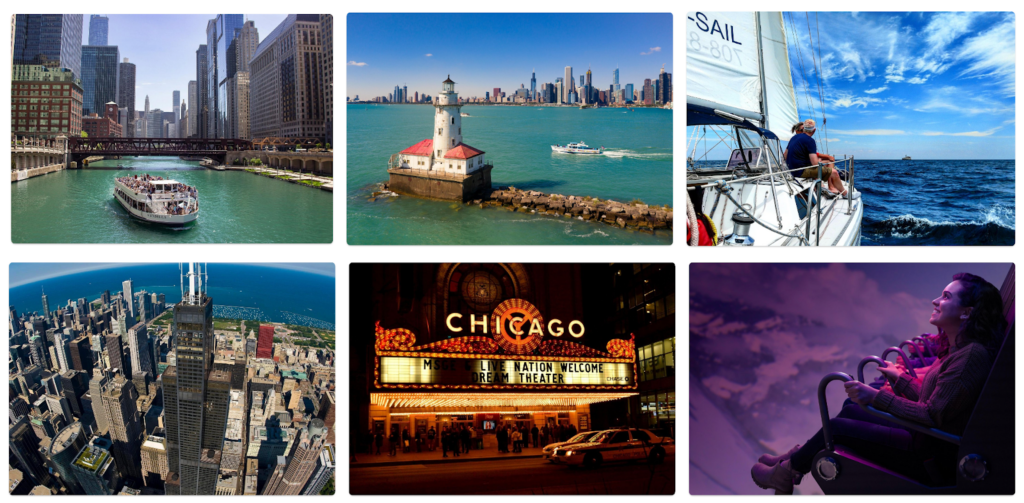
Navy Pier operates as a lakefront entertainment district attracting more than 8 million visitors annually. It allows groups to layer multiple experiences within walking distance, including cruises, waterfront dining, observation rides, immersive attractions, and seasonal programming.
The district supports school field trips, corporate outings, conference overflow sessions, senior groups, and regional visitors arriving from surrounding suburbs or nearby states. For planners, the advantage is in operational ease and clarity. Groups can arrive once, establish a central meeting point, sequence fixed-time activities, and depart together without fragmenting across neighborhoods.
This guide explains how to plan a large group outing to Navy Pier so the day runs on time and stays coordinated. It covers how to structure the itinerary around fixed-time activities, sequence experiences within the Pier, choose the right transportation, and handle common issues like delays, walking distances, and group movement.
Table of Contents
Navy Pier for Large Group Itineraries
It Works Because It’s Modular
Navy Pier supports multiple pacing models. A half-day program might begin with a coordinated arrival, followed by a 90-minute architecture or lake cruise. From there, the group transitions into lunch or an indoor attraction before departing within a defined schedule window.
A full-day itinerary expands naturally. The morning can anchor around a river or lake cruise, the afternoon can layer in an immersive experience or nearby cultural attraction, and the evening can close with lakefront dining or seasonal fireworks before a unified departure.
Experiences can be sequenced within a contained footprint, protecting time and keeping the group aligned.
Navy Pier’s Appeal to Core Group Types
Different groups use Navy Pier differently; the table below highlights how the experience aligns with each audience type:
| Core audience | How Navy Pier works for the group |
| School and Educational Groups | Compact layout reduces supervision risk. Students can move between activities without navigating city streets. |
| Corporate and Conference Groups | Lake cruises and private sailings create contained networking environments. Proximity to downtown hotels and McCormick Place supports efficient routing. |
| Tourist and Regional Groups | Visitors from Milwaukee, Naperville, or O’Hare can access skyline views, Lake Michigan experiences, and curated attractions within a single district. |
| Event and Sports Groups | Post-game or post-conference outings transition easily into evening cruises or lakefront programming without coordinating multiple rideshare departures. |
When Does a Charter Bus to Navy Pier Make Sense?
For small groups, typically under 8 people traveling within the city, separate cars or public transit may be practical. However, once a group reaches 12–15 passengers, coordination, parking, and timing begin to introduce friction.
For large groups, particularly those arriving from suburbs, coordinating fixed-time activities, or planning a multi-stop day, a charter bus becomes operationally efficient.
The comparison below outlines how common transportation options perform:
| Factor | Separate Cars | Public Transit / Rideshare | Charter Bus |
| Arrival Control | Staggered arrival times | Dependent on train schedules or surge pricing | Single, synchronized arrival window |
| Fixed-Time Activities | Risk of late arrivals missing the cruise boarding | Transfers and delays increase timing risk | Schedule aligned to boarding windows |
| Cost Predictability | Variable parking, tolls, fuel | Surge pricing after events; multiple fares | One defined transportation cost |
| Departure After Fireworks or Events | Garage congestion and staggered exits | Long rideshare queues, train crowding | Unified departure |
| Group Cohesion | Fragmented start and end of the day | Group disperses across vehicles | The group travels together throughout |
Where Should Your Group Start?
Most planning mistakes happen because transportation is booked before the day is structured.
Before selecting a vehicle, confirm three variables: purpose, anchor activity, and time window.
1. Clarify the Purpose of the Trip
The objective determines everything that follows.
- Is this a structured educational outing?
- A networking-focused corporate event?
- A sightseeing-heavy regional visit?
- A post-conference or post-game extension?
A 15-person leadership group has different pacing needs than a 45-student field trip. Define the outcome first, then design around it.
2. Choose One Fixed-Time Anchor
Navy Pier works best when the day is anchored around a scheduled experience. Common anchors include the Chicago River 90-Minute Architecture Boat Tour, City Cruises Chicago (lunch, brunch, dinner, fireworks sailings), or the Flyover in Chicago.
These experiences operate on boarding windows. If a cruise departs at 1:00 PM, a late arrival means missed access. That single departure time should dictate your arrival schedule, buffer planning, and return routing.
3. Define the Time Window
Decide early whether you are planning. Half-Day (4–5 hours total) works best for conference breakouts, short corporate outings, or local school trips. Full-Day (6–9 hours total) is ideal for regional tourist groups, suburban school programs, or multi-stop Chicago itineraries.
Your time window influences several key decisions, such as whether a restroom-equipped motorcoach is appropriate, whether additional stops such as Skydeck or Millennium Park are realistic, and whether meal service should be integrated into the schedule.
4. Determine If Navy Pier Is the Main Destination or One-Stop
For some groups, Navy Pier is the full experience. For others, it is one segment of a broader Chicago day that may include Skydeck Chicago – Willis Tower, Millennium Park, or the Museum Campus.
If multiple stops are planned, sequencing becomes critical. Travel time between neighborhoods, boarding windows, and congestion near the lakefront all affect how tightly the schedule can be built.
The Planning Order That Prevents Problems
- Confirm group size
- Select an anchor experience and book it
- Define the total time window
- Add secondary activities if time allows
- Then secure transportation aligned with that structure
Transportation should protect the schedule you designed, not force changes to it.
Best Activity Anchors at Navy Pier (And Who They’re Ideal For)
School and Educational Groups
School trips require more structure, supervision, clarity, and predictable timing windows. Navy Pier works best when activities are educational but contained. Popular activities include:
| Activity | Why It Works for Schools | Time Commitment | Planning Notes |
| Chicago River 90-min Architecture Boat Tour | STEM & history-focused. Covers engineering, urban development, & architecture | 90 minutes + 30-minute boarding buffer | Strong primary anchor; arrival timing must align with departure window |
| Chicago Sightseeing River and Lake Cruise | Broader skyline storytelling suitable for mixed-age groups | 90 minutes | Works well as the central half-day anchor |
| Flyover in Chicago | Immersive, weather-proof indoor experience | 30–45 minutes | Contingency if lake conditions shift; easy to schedule between larger blocks |
| Chicago Scavenger Hunt (Self-Guided) | Structured but flexible group engagement within the Pier district | 2–3 hours (adjustable) | Best layered after a fixed-time cruise |
| Skydeck – Willis Tower (paired stop) | Adds skyline and structural learning perspective | 60–90 minutes (offsite) | Requires additional routing and sequencing |
For planners looking for a quick way to compare options, check real-time availability, and organize bookings in one place, Viator provides a streamlined platform to coordinate these Chicago experiences before finalizing transportation logistics.
Corporate and Conference Groups
Navy Pier works best for corporate and conference groups when activities balance structured networking with defined timing windows. Popular options include:
| Activity | Why It Works for Corporate Groups | Time Commitment | Planning Notes |
| City Cruises Chicago – Signature Lunch Cruise | Structured networking in a contained, scenic environment | 2 hours | Boarding windows are strict; arrival timing matters |
| City Cruises Chicago – Fireworks Signature Dinner Cruise | Premium evening experience during the summer months | 2–3 hours | High demand; advance booking recommended |
| Private Sailing on Lake Michigan – Navy Pier | Executive-level small group setting ideal for leadership teams | 2 hours | Best suited for 10–15 guests; schedule-sensitive |
| Private Chicago River Architecture Boat Tour | More conversation-friendly than larger public cruises; strong for client hosting | 90 minutes | Confirm private availability and boarding windows |
| Flyover in Chicago (Pre-Dinner Programming) | Structured 45-minute indoor experience before dinner or evening events | 30–45 minutes | Works well as a pre-dinner timing buffer |
Tourist and Regional Visitor Groups
Navy Pier works best for regional and visiting groups when activities deliver strong skyline views, Lake Michigan access, and high-visibility Chicago experiences within a compact time window. Popular options include:
| Activity | Why It Works for Tourist & Regional Groups | Time Commitment | Planning Notes |
| Chicago River 90-Minute Architecture Boat Tour | Most efficient skyline orientation experience with guided city context | 90 minutes + boarding buffer | Strong primary anchor for first-time visitors |
| Lake Michigan 30-Minute Speedboat Ride | Short, high-energy lakefront experience | 30 minutes | Works well as a midday add-on between longer activities |
| Chicago’s Fireworks Show aboard Tall Ship Windy | Seasonal evening highlight with skyline backdrop | 90 minutes | Best used as the evening anchor during the summer months |
| Chicago Sightseeing River and Lake Cruise | Balanced skyline and open-water exposure | 90 minutes | Suitable for mixed-age regional groups |
| Skydeck – Willis Tower (paired stop) | Complements lakefront views with an elevated skyline perspective | 60–90 minutes (offsite) | Requires routing coordination if added to Pier programming |
Event and Sports Groups
Navy Pier works well for event and sports groups when activities provide a defined pre- or post-event extension without requiring additional cross-city coordination. Popular options include:
| Activity | Why It Works for Event & Sports Groups | Time Commitment | Planning Notes |
| City Cruises Chicago – Signature Brunch Cruise | Structured daytime extension before or after games, tournaments, or conferences | 2 hours | Boarding windows are fixed; align arrival accordingly |
| City Cruises Chicago – Fireworks Signature Dinner Cruise | Strong evening capstone during the summer months | 2–3 hours | High demand on event nights; book early |
| Small-Group Sightseeing Boat Tour in Chicago | Flexible, lower-capacity option for groups under 20 | 90 minutes | Easier boarding logistics for smaller teams |
| Flyover in Chicago | Weather-safe, structured indoor programming | 30–45 minutes | Useful buffer between game schedules or event sessions |
| Lake Michigan 30-Minute Speedboat Ride | Short, high-energy activity between larger commitments | 30 minutes | Works best when time is limited but energy is high |
Sample Itineraries by Group Size (15, 25, 40 Passengers)
15 Passengers: Corporate Leadership Half-Day (Navy Pier Anchor)
A 15-person group sits at a tipping point of coordination. It is small enough to feel manageable, but large enough that staggered arrivals, parking variability, or multiple rideshares can disrupt experiences. For this size, transitions matter as much as the anchor activity.
Recommended Structure (4.5–5 Hours Total)
| Time Marker | Activity & Planning Notes |
| T-60 | Consolidated pickup window (downtown office or hotel). A single departure protects the schedule from staggered arrivals and route variability. |
| T-30 | Arrival buffer at Navy Pier. Account for walking time and boarding check-in. Navy Pier stretches more than half a mile; mid-pier docks require internal transit time. |
| T (Anchor) | Chicago River 90-min Architecture Boat Tour. Boarding windows are firm. Plan arrival based on the boarding call, not the printed departure time. |
| T+90 to T+150 | Structured lunch block. Options include a pre-reserved Pier restaurant or a scheduled lunch cruise. Keep this window defined to protect momentum. |
| T+150 to T+210 (Optional) | Flyover in Chicago. A 30–45 minute indoor experience works well as a predictable buffer between lunch and departure. |
| T+210 to T+300 | Coordinated departure window. Leaving together prevents the end-of-day slowdown that often follows cruises or waterfront dining. |
Why This Works for 15
Avoids transition drift: multiple vehicles arriving at different times, confusion around pickup locations along the Pier’s long curbside loop, or lost buffer time before fixed boarding windows.
A consolidated vehicle removes variability from the most fragile part of the day — the movement between experiences. The cruise or dining experience may be the visible highlight, but the protected transitions are what keep the schedule intact.
25-Person Group: Regional Visitors Half-Day
At 25 passengers, the itinerary succeeds or fails on transition control. Lunch, regrouping, and cross-town transfers take longer than planners expect, so the schedule should protect buffer time rather than treat it as optional.
Recommended Structure (5–7 Hours Total)
| Time Marker | Activity & Planning Notes |
| T-90 to T-75 | Pickup window (hotel, downtown meeting point, or suburban origin). Plan a wider loading window. Boarding, headcounts, and late arrivals take time at this size. |
| T-45 | Arrive at Navy Pier with a buffer. This protects the boarding window and accounts for curbside congestion on weekends and event days. |
| T (Anchor) | Chicago Sightseeing River and Lake Cruise. Use this as the fixed-time spine of the itinerary. Plan for the boarding call, not the printed departure time. |
| T+90 to T+180 | Lunch block (90 minutes). For 25 people, a seated lunch regularly runs long unless the meal is pre-ordered or buffet-style. Treat 90 minutes as the default. |
| T+180 to T+285 | Offsite skyline stop: Skydeck – Willis Tower (paired stop). Allow time for transfer, entry/security, elevator queues, and photos. If your admission is timed, build in an extra buffer rather than aiming to arrive exactly at the window. |
| T+285 to T+390 | Return routing and coordinated drop-off. If multiple drop-offs are required, set the order in advance and define a latest acceptable arrival time for the final stop. |
Why This Works for 25
At 25 passengers, the primary risk is schedule compression driven by real-world friction: regrouping after lunch, queueing at attractions, and variable cross-town travel times. By expanding the lunch window and giving the off-site stop a realistic time block, the itinerary protects buffers and prevents one small delay from cascading into missed entries or rushed experiences.
40-Passenger Group: School Field Trip Half-Day (Navy Pier Anchor + Indoor Stabilizer)
At 40 passengers, the schedule is shaped less by the headline activities and more by predictable “time taxes” on loading, restroom breaks, regrouping, and queues. This itinerary builds those realities in so that fixed-time experiences stay protected.
Recommended Structure (4–6 Hours Total)
| Time Marker | Activity & Planning Notes |
| T-120 to T-95 | Pickup window (school or staging lot). Use a wider window for attendance checks, seating assignments, and bag loading. Aim to have the “all aboard” call before the planned roll time. |
| T-55 | Arrive at Navy Pier with buffer. Allow time to unload, regroup, and walk as a unit to the next checkpoint. |
| T-55 to T-35 | Arrival bio-break + regroup. Build a defined restroom window and reassemble at a pre-set meeting point before moving toward the dock. This prevents last-minute drift right before boarding. |
| T (Anchor) | Chicago River 90-min Architecture Boat Tour. Plan the boarding call. Keep chaperones positioned front and back during the walk-in to maintain group integrity. |
| T+90 to T+165 | Controlled lunch block (75 minutes). For this group size, the most reliable approach is boxed lunches or a pre-ordered group meal. Set a clear “meet-back” time and location to avoid fragmentation. |
| T+165 to T+210 | Flyover in Chicago (structured indoor block). Predictable duration and weather-proof. Works well after lunch when energy dips and timing needs to stay tight. |
| T+210 to T+345 | Regroup + coordinated departure window. Use the same meeting-point logic as arrival. Add a contingency buffer for slow disembarkation from the cruise or unexpected queueing. |
Why This Works for 40
At this size, small delays compound. By explicitly planning for loading time, a structured arrival bio-break, and a controlled lunch window, the itinerary protects the boarding window for the cruise and keeps the group aligned through transitions.
Choosing the Right Bus for a Navy Pier Trip
Vehicle Selection by Group Size and Use Case
| Group Size / Scenario | Recommended Vehicle | When It Makes Sense | Notes for Navy Pier Trips |
| 8–14 passengers | Sprinter Van | Short-duration trips, downtown pickups | Easier curb access; limited luggage capacity |
| 15–30 passengers | Minibus (24–35 passenger range) | Corporate outings, regional visitors, single-anchor days | Balanced maneuverability & capacity; ideal for multi-stop routing |
| 30–40 passengers | 40–56 Passenger Motorcoach | School groups, full-day programs, suburb departures | Under-bus storage helpful for backpacks and purchases |
| Multi-stop + Long Duration (6+ hours) | Motorcoach with a restroom | Suburban or airport-origin groups | Restroom reduces unscheduled stops; verify availability in advance |
| ADA Requirements | ADA-Accessible Coach | Mobility needs within group | Confirm lift access and seating layout early |
Vehicle choice should follow the itinerary design. Duration, boarding windows, luggage, and supervision needs matter more than just headcount.
What Groups Often Overlook at Navy Pier
Even well-structured itineraries can unravel because of small, predictable friction points. Most scheduling problems at Navy Pier stem from movement, timing, and regrouping between phases of the day. The following factors regularly affect group visits:
- Walking distance inside the Pier — It stretches more than half a mile end to end.
- Boarding call vs departure time — Cruises board before they depart.
- Fireworks congestion — Departure traffic compresses quickly.
- Lunch duration realism — 25+ passengers rarely complete seated service in 60 minutes.
- Queue stacking — Large groups multiply entry and security times.
- Multiple drop-offs — Set stop order before departure.
Most delays occur during transitions, not during the main activity.
Planning Checklist Before You Request a Quote
Before requesting transportation pricing, clarify the structural elements of your day. The more defined your itinerary, the more accurate and predictable your quote will be.

Group Planning Checklist: Navy Pier
Once these variables are defined, transportation pricing becomes predictable, and the day can be structured around protected time windows.
Making Navy Pier Work for Your Group
Navy Pier offers density: cruises, skyline views, lakefront dining, and immersive attractions within a contained footprint. The difference between a smooth group experience and a compressed one is not the activity itself, but how the day is structured around it.
Start with the anchor. Define the time window. Add only what the schedule can realistically support. Then choose transportation that protects those decisions. When arrival, boarding, lunch, and departure are treated as controlled phases rather than afterthoughts, the day holds together. And when the schedule holds, the experience does too.
Frequently Asked Questions
What is the best way to plan a group outing to Navy Pier?
Start with one fixed-time activity like a cruise, define your total time window, then add secondary experiences. Finalize transportation last to support the schedule.
How early should groups arrive before a cruise at Navy Pier?
Arrive at least 30–45 minutes before boarding. Cruises load before departure, and walking distances within the Pier can add unexpected time.
When does a charter bus make sense for Navy Pier trips?
For groups of 12–15 or more, especially with fixed schedules or multiple stops. It keeps arrivals synchronized and simplifies departure after events or fireworks.
Can Navy Pier be combined with other Chicago attractions?
Yes. Common pairings include Skydeck Chicago, Millennium Park, or Museum Campus. Plan routing carefully to avoid delays and protect boarding windows.
What are common mistakes when planning group trips to Navy Pier?
Underestimating walking distances, treating boarding time as departure time, scheduling tight lunch windows, and not planning clear meeting points for regrouping.