

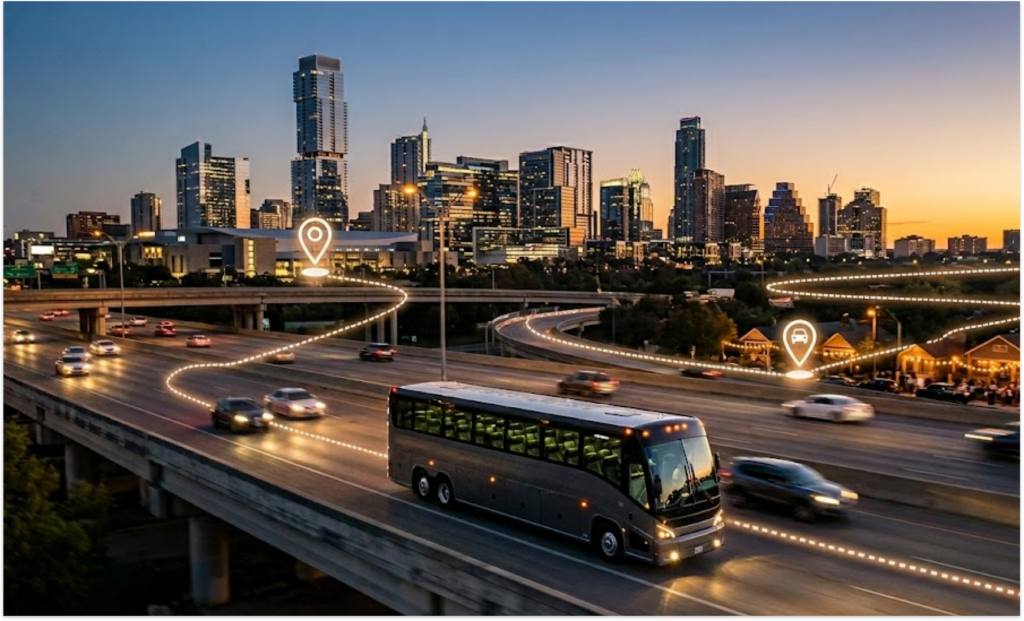
Austin group transportation often looks simple until the day starts crossing districts. A group may load cleanly at The Domain in North Austin, then head downtown for a dinner, music event, conference program, or Rainey Street outing. The first pickup can be orderly. The return is where the plan gets tested: guests split up, rideshare demand rises, curb space gets tight, and the exact pickup point matters more than anyone expected earlier in the day.
This guide is for corporate planners, meeting teams, association staff, festival-adjacent groups, and event organizers planning large group transportation in Austin. It focuses on the movements that need real planning: The Domain to downtown, Rainey Street returns, Palmer Events Center programs, airport-area hotels, event nights, and vehicle choices that match the structure of the trip.
Austin Group Transportation Works By District
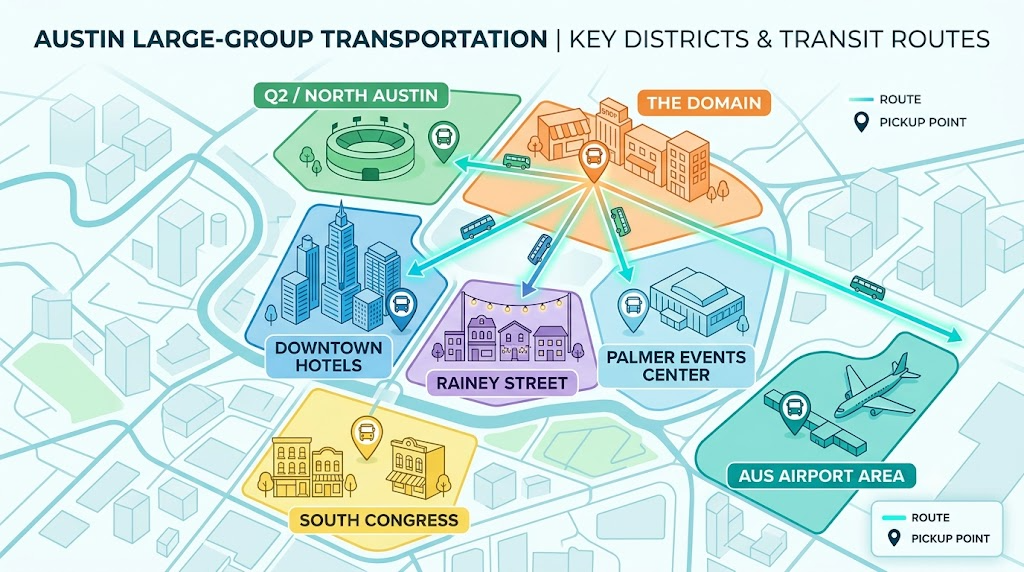
Austin has several transportation environments inside the same city. A plan that works around The Domain may need a different setup downtown. A downtown hotel pickup may be easy in the afternoon and harder after a show. A Rainey Street return may require a different vehicle and pickup point than the outbound ride.
The table below shows how the planning question changes across Austin districts:
| Austin zone | What changes for transportation planning |
| The Domain and North Austin | Easier consolidated pickups, but longer cross-city moves into downtown or Rainey Street. |
| Downtown hotels | Strong hotel density, but curb space, timing, and event crowds still shape pickup plans. |
| Rainey Street | Late-night pedestrian traffic, limited curb space, and scattered guests make returns more fragile. |
| Palmer Events Center | A practical event anchor while the Austin Convention Center is closed, with hotel pickups often coming from several areas. |
| UT / Moody Center | Event-night crowd releases can affect pickup timing and staging. |
| South Congress and East Austin | Good for dinners and outings, but pickup points can be less obvious for larger groups. |
| Q2 Stadium and North Austin venues | Useful for North Austin event plans, especially when paired with Domain-area hotels. |
| AUS-area hotels | Convenient for arrivals, less convenient for repeated trips into downtown or The Domain. |
The right Austin plan starts with three questions:
- Where is the group starting?
- Where does the night end?
- Does the vehicle need to return once, wait nearby, or make multiple pickup trips?
What To Know About The Austin Convention Center Closure
With the Austin Convention Center closed for expansion and redevelopment through December 2028 / early 2029, planners working in Austin need to account for a more distributed meeting landscape.
As a result, more programs are being built around hotel-based meetings, off-site venues, Palmer Events Center, private dinners, live-music outings, and distributed event schedules. Transportation still matters because the movement is spread across more places.
For group transportation, the closure can mean:
- more hotel-to-venue movement instead of a single convention-center anchor
- more pickups from downtown hotels, South Congress, The Domain, and airport-area properties
- more evening movement to restaurants, music venues, and hospitality events
- need for carefully defined pickup points before the event day
- more value in convention shuttle planning when attendees are split across several locations
What matters is timing. Confirm the venue mix first, then build transportation around the actual map.
The Domain As A North Austin Group Base
The Domain acts like a North Austin base for many corporate and group programs. Hotels, restaurants, offices, retail, and entertainment sit close together.
For a planner, The Domain works well when:
- most attendees are staying in or near the district
- the group starts from one hotel or a small hotel cluster
- the outing is based around North Austin dining, shopping, sports, or entertainment
- the group is moving as one unit to downtown, Palmer, Rainey Street, or a live-music venue
The Domain can simplify the first load, but that ease does not carry over once the itinerary moves south.
For groups based at The Domain, a motorcoach can work well when the group is consolidated and traveling together. A mini bus may be cleaner for smaller teams, staggered hotel pickups, or tighter return points. If leadership or VIP guests are on a different schedule, a sprinter van can support that smaller movement without reshaping the main group plan.
Moving From The Domain To Downtown Or Rainey Street
The Domain-to-downtown move is where Austin group transportation gets harder. MoPac, I-35, peak-hour traffic, and event-night demand all add time, and the destination and return need more planning than the outbound ride.
Before the group leaves The Domain, planners should already know:
- the exact downtown or Rainey Street drop-off point
- whether the vehicle waits, leaves, or returns later
- where the group meets for pickup after the event
- whether the return happens once or in waves
- who communicates pickup instructions to attendees
- what the fallback pickup point is if the first point becomes impractical
This matters most for dinners, live music, hospitality events, and nights that include alcohol. The outbound ride has a fixed start. The return has more variables. Guests may move at different speeds, leave from different exits, continue to another bar, or request rideshares before the group is ready.
For a fixed dinner, a roundtrip can be enough. For a networking night or open-ended event, hourly service may be better because the vehicle remains tied to the group. If guests are expected to leave in phases, staged returns or smaller vehicles may make more sense than one large vehicle waiting for everyone.
Rainey Street And Downtown Event-Night Returns
Rainey Street creates a specific kind of Austin transportation problem. It is popular, pedestrian-heavy, and physically tighter than a planner might expect if they only look at the destination name on an itinerary.
For a small group, that may only mean choosing a meeting point. For a group of 20, 40, or more, it changes the whole return plan. Common failure points include:
| Problem | What to do before the event |
| Guests scatter after dinner or drinks | Tell attendees the return pickup point before they arrive. |
| The vehicle cannot wait at the most obvious curb | Confirm a practical pickup point and a fallback location. |
| The group leaves in waves | Use hourly service, staged returns, or multiple smaller movements. |
| Some guests try to leave by rideshare | Make the group plan clear before the event starts. |
| Street or event conditions change | Confirm date-specific access close to the event. |
Downtown Austin has similar issues around entertainment districts, live-music venues, and event-night crowds. Sixth Street, Red River, ACL Live, Moody Center, and other central areas can change quickly based on the date, event, crowd size, and city traffic management.
The safer approach is to build the plan around the exact date, venue, pickup point, and return window. Our operators can help confirm the route logic before the trip so planners know where the group should regroup.
Palmer Events Center And Distributed Meeting Movement
Palmer Events Center is another practical anchor while the Austin convention-center redevelopment is underway. If your program uses Palmer, the transportation plan should account for its downtown-adjacent location, nearby hotel inventory, and the fact that attendees may still be coming from several Austin districts.
That makes Palmer useful for conferences, expos, association meetings, corporate programs, and public events. It also creates a transportation question: where are attendees actually staying?
A Palmer event may draw guests from:
- downtown hotels
- South Congress hotels or restaurants
- The Domain or North Austin
- airport-area hotels
- off-site dinner or reception venues after the event
If attendees are close to Palmer, walking or short transfers may work for some portions of the group. Larger groups, formal events, accessibility needs, weather, and timed arrivals can still justify scheduled transportation.
For a Palmer program, the shuttle plan should answer:
- which hotels are close enough to walk
- which hotels need scheduled pickup
- whether a central pickup point is cleaner than door-to-door hotel stops
- whether the group returns to the same hotels or moves to an evening event
- how the plan changes if attendees leave at different times
This is where group transportation planning becomes more useful than a simple vehicle booking. The vehicle matters, but the pickup sequence and return pattern decide whether the day runs cleanly.
Downtown Hotels, South Congress, And East Austin
Downtown Austin gives planners a large hotel base, with more than 14,000 rooms in the central downtown district and a separate Palmer-area hotel cluster with more than 12,000 nearby guest rooms.
While that density helps, the transportation plan still depends on the actual hotel block. A single nearby hotel, several adjacent hotels, and a spread-out downtown block each call for a different pickup setup.
| Hotel setup | Transportation approach |
| One nearby hotel | Fixed departure or walking may be enough. |
| Several nearby hotels | A central pickup point may be cleaner than multiple hotel doors. |
| Hotels spread across downtown | Use pickup waves or separate routes. |
| Formal event or accessibility needs | Door-side coordination may matter more than shortest distance. |
| Evening return after dinner or music | Plan the pickup point and return time before guests leave. |
South Congress and East Austin are strong outing districts, especially for dinners and informal group experiences, but they can be less straightforward for a large vehicle.
For those districts, planners should decide whether the group arrives together, leaves together, or splits into smaller returns. A small team dinner may work with a sprinter or mini bus. A larger corporate group may need one consolidated drop-off and a carefully timed return from a nearby pickup location.
Major Austin Event Spikes That Change The Plan
Austin has several events that can change normal transportation assumptions. Planners should account for event-spike days before choosing a vehicle or pickup location. High-impact examples include:
| Event or venue | Why it matters for group transportation |
| SXSW | Multiple venues, long days, and shifting attendee schedules can make fixed pickup instructions important. |
| ACL Fest | Zilker Park event traffic can push pickups farther from where attendees expect to exit. |
| Circuit of The Americas / Formula 1 | Large event traffic and longer venue access patterns require early routing and return planning. |
| DKR-Texas Memorial Stadium | Texas football weekends can affect UT-area traffic and downtown hotel movement. |
| Q2 Stadium | Austin FC and stadium events can pair naturally with North Austin or Domain-area hotels. |
| Moody Center | Concerts and UT events create concentrated arrival and departure waves near campus. |
The common lesson is practical: date-specific conditions can override the normal plan. During SXSW, ACL Fest, F1 weekend, Texas football, or a major arena event, the group should not improvise the return after the event ends.
For larger programs, public event and festival transportation may need a different structure from a normal dinner shuttle. The pickup point may be farther away. The wait time may be longer. The route may need to avoid the most obvious streets. The final plan should be confirmed close to the event date.
Austin-Bergstrom Airport And Airport-Area Hotels
Austin-Bergstrom International Airport matters most when the group is flying in, staying near AUS, or starting the trip from an airport-area hotel.
Since April 1, 2026, Allegiant and Frontier flights have operated from the Barbara Jordan Terminal, after the South Terminal closed on March 31, 2026 as part of the airport’s ongoing expansion program, bringing commercial airline operations under one roof.
For planners, the larger point is that airport guidance can change during expansion. If the trip includes AUS, confirm the current arrival, pickup, and construction details before the service date.
Airport-area hotels can work well for:
- arrival consolidation
- early departures
- one-night meetings
- groups with flight-heavy schedules
They can become less efficient when the group repeatedly travels to The Domain, downtown, Palmer Events Center, Rainey Street, or event venues. A hotel that is convenient for flights may add time to every program movement.
For airport arrivals, a one-way transfer may be enough. For a program that continues into downtown or North Austin, the airport leg should be treated as one part of a larger transportation plan.
Choosing The Right Austin Service Model
The service model should come before the vehicle choice. Austin trips fail when the group books capacity but has not decided how the evening actually ends.
| Service model | Best Austin fit |
| One-way transfer | AUS arrivals, single hotel-to-venue moves, or groups ending in a different district. |
| Roundtrip transfer | Fixed dinners, Palmer programs, concerts, sports nights, and planned outings. |
| Hourly service | Flexible dinners, networking events, live music, or nights that may run long. |
| Continuous shuttle | Hotel-to-venue movement, conference-style loops, and staggered arrivals. |
| Staged return | Rainey Street, downtown nightlife, festivals, and events where guests leave in waves. |
A round-trip works when the return time is clear. Hourly service works when the end time may shift. A continuous shuttle works when guests move across a wider window. Staged returns work when the group is likely to split.
The Domain-to-Rainey example shows the difference. A team dinner with a firm ending may only need one outbound and one return. A client hospitality night with drinks, music, and optional departures may need hourly coverage or return waves.
Choosing The Right Vehicle Mix
Austin’s vehicle choice should follow the pickup environment, the group size, and the return plan.
A sprinter van can work for executives, VIP guests, smaller teams, site visits, and separate schedules. It can also help when a large program has a small leadership group moving separately from the main attendee group.
A mini bus is often a good fit for mid-sized groups, hotel loops, dinner transfers, and segmented service. It gives planners more flexibility when the group is too large for rideshare but does not need a full coach.
A motorcoach makes sense when the group can load together, the passenger count is higher, or the route benefits from moving the group in fewer cycles. Domain-to-downtown transfers, airport arrivals, larger corporate outings, and event-night returns can all justify coach-level capacity.
Mixed fleets can be useful when the plan has two different transportation problems. A coach can handle the main group. Mini buses can cover hotel loops or smaller return waves. Sprinters can support VIPs or late departures.
The wrong approach is to choose only by headcount. The better question is: what vehicle fits the pickup point, the return window, and the way the group will actually move?
Austin Planning Checklist
Before finalizing an Austin charter bus or shuttle plan, lock down the items below.
| Planning item | Why it matters in Austin |
| Starting zone | The Domain, downtown, AUS-area hotels, and South Congress create different route plans. |
| Final return point | The return often creates more friction than the outbound ride. |
| Group departure style | One return time needs a different setup from staged returns. |
| Venue or district access | Downtown, Rainey, campus, festival, and stadium conditions can change by date. |
| Vehicle size | Capacity matters, but curb access and pickup environment matter too. |
| Time buffer | Cross-city moves from North Austin to downtown need realistic timing. |
| Pickup instructions | Guests should know the return point before the event starts. |
| Onsite contact | One person should be able to confirm when the group is ready to board. |
| Fallback pickup point | Useful for Rainey Street, downtown events, and festival nights. |
| Airport details | AUS pickups should reflect current terminal and construction guidance. |
This checklist keeps the focus on the real planning work: where the group starts, where it regroups, how the vehicle fits, and how the return happens.
Austin Group Outings To Consider (Viator)
Austin gives planners several strong options for client outings, team nights, conference add-ons, and structured free-time blocks. Our partner Viator has experiences that work well for groups.
Here are some Austin experiences worth considering for group itineraries:
| Viator experience | Who it suits and why it works |
| Downtown Austin Food Tour with Private Tour Upgrade Option | Good for client hosting, small executive groups, and teams staying downtown. The walking format keeps the activity concentrated, so the transportation plan can focus on one arrival point and one return pickup. |
| Austin Live Music Crawl | Good for groups that want an Austin-specific evening without building a custom nightlife route from scratch. |
| Haunted Austin Walking History Tour | Good for conference attendees or association groups that want a lighter evening program. A defined walking-tour window makes it easier to plan a single pickup after the activity. |
| Lake Austin Small-Group Scenic Boat Tour | Good for smaller breakout groups, incentive guests, or partner outings. The boat time gives planners a clear activity window, while charter bus transportation can handle movement to and from the marina or meeting point. |
| Texas Capitol tickets and tours | Good for association, nonprofit, government-adjacent, and education-focused groups. It pairs naturally with downtown hotel blocks and can be scheduled before an evening event. |
| Bullock Texas State History Museum tickets and tours | Good for daytime programming, family-friendly groups, and attendees with a structured free-time block. It works best when the group has a planned drop-off and a fixed return time. |
| Congress Avenue Bridge tickets and tours | Good for groups that want a recognizable Austin stop near downtown. Because evening crowds can build up around the bridge, the pickup point should be set before the group walks over. |
The same rule applies here as it does to the rest of the Austin plan: choose activities that make the transportation plan easier to manage. If the experience has a defined start point, realistic duration, and one return location, it is easier to fit into a group schedule.
Conclusion
Austin group transportation works best when the route, pickup point, vehicle, and return window are planned together.
The Domain can make the first pickup easier. Downtown, Rainey Street, Palmer Events Center, SXSW, ACL Fest, Moody Center, COTA, and airport-area hotels each add their own planning questions. The bus is only one part of the answer. The service model, return timing, and pickup instructions matter just as much.
At BusBank, we help planners structure Austin transportation around the actual day: where the group starts, where the event happens, and how everyone gets back. For corporate outings, convention movement, airport arrivals, live-music nights, festival weekends, and multi-stop programs, the right plan should be clear before the first passenger boards.
FAQs
What is the best way to get a large group from The Domain to downtown Austin?
For large groups going from The Domain to downtown Austin, start with one consolidated pickup if most attendees are staying near The Domain. Then set the downtown return point, pickup time, and communication plan before the group leaves North Austin.
Can a charter bus pick up a group on Rainey Street in Austin?
A charter bus can work for a Rainey Street group outing, but the pickup point needs to be planned carefully. Rainey Street is a tight, pedestrian-heavy Austin nightlife district, so larger groups may need a nearby regrouping point instead of assuming the bus can stop at the most obvious curb.
Should a downtown Austin event group book round-trip or hourly charter bus service?
Round-trip charter bus service works for a downtown Austin dinner, concert, or event with a fixed end time. Hourly service is usually better when the night may run long, guests may leave in smaller groups, or the planner wants the vehicle available through the event window.
What type of bus works best for a group trip from The Domain to Rainey Street?
For a Domain-to-Rainey Street group outing, the best vehicle depends on group size and return timing. A motorcoach can work when the full group travels together, while a mini bus or mixed-fleet setup may fit better when the return point is tighter or guests leave at different times.
How should Austin groups handle late-night transportation after live music or drinks?
For Austin live music, dinner, or nightlife plans, decide the pickup point, return window, and attendee instructions before the event starts. If guests may split up, staged returns or hourly service can reduce confusion at the end of the night.
Are Austin airport-area hotels convenient for group transportation to downtown or The Domain?
Austin airport-area hotels are convenient for flight arrivals and early departures. They are less efficient when the group repeatedly travels to The Domain, downtown Austin, Palmer Events Center, Rainey Street, or event venues because each program movement adds more drive time.
How does group transportation in Austin change during SXSW, ACL Fest, F1, or Texas football weekends?
During SXSW, ACL Fest, Formula 1 at Circuit of the Americas, or Texas football weekends, Austin traffic patterns, pickup access, rideshare demand, and walking routes can change. For those dates, confirm routing and pickup logic close to the event and avoid relying on same-day improvisation.