

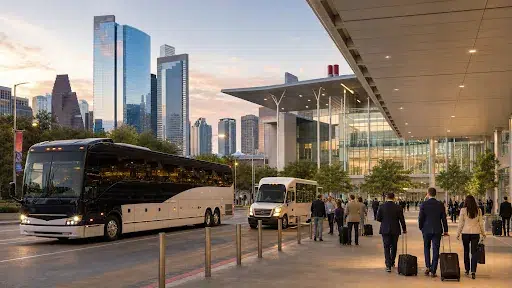

Convention transportation in Houston can look easy when the event is centered on George R. Brown Convention Center. GRB sits in the Avenida Houston district, with Discovery Green in front, Toyota Center nearby, Daikin Park close enough for event-night plans, and two convention headquarter hotels connected to the convention center by skybridges.
That setup helps. Once attendees are spread across downtown hotels, airport-area properties, Galleria / Uptown hotels, Medical Center stays, or evening venues, the planner has a different problem. The route has to move people at the right time, through the right pickup points, with enough buffer for Houston weather, traffic, construction, and post-event crowds.
This guide is for meeting planners, convention teams, association staff, corporate planners, and event organizers planning Houston charter bus and shuttle service around GRB, downtown hotel blocks, IAH, HOU, Toyota Center, Daikin Park, NRG Park, Space Center Houston, and other Houston group destinations.
Houston Convention Transportation Starts With The Hotel Map
For most GRB conventions, the first planning question is where people are staying. Vehicle size comes later.
A group staying at Hilton Americas-Houston or Marriott Marquis Houston has a different transportation need from a group split across five downtown properties. A group with airport-area overflow hotels has a different day from a group staying in the immediate Avenida Houston district. A group that ends the night at Toyota Center has a different return problem from a group traveling to NRG Park or Space Center Houston.
At the zone level, the plan looks like this:
| Houston planning zone | Transportation implication |
| Downtown hotel blocks | Range from skybridge-connected access to short walks to dedicated shuttle routes. The right model depends on distance, weather, group size, and timing. |
| Outlying hotel blocks | Galleria / Uptown, Medical Center, and airport-area properties need dedicated routing. Repeated GRB trips add significant time without a plan. |
| IAH and HOU | Airport choice affects transfer time, luggage handling, and whether arrival groups can be consolidated. |
| Event venues | Nearby venues like Toyota Center and Daikin Park are usually crowd-staging problems. Cross-city moves to NRG Park, the Museum District, and Space Center Houston need dedicated vehicles and a clear return window. |
The route should follow that map. A single loop that tries to serve every property can become slow before the first session begins.
How The GRB And Avenida Houston District Works
George R. Brown Convention Center is one of the largest convention centers in the United States, and Houston First places it at 1.9 million usable square feet. The convention center sits on Avenida de las Americas, inside the broader Avenida Houston convention and entertainment campus.
For planners, the useful point is the campus layout:
- GRB sits next to Discovery Green.
- Avenida Houston includes restaurants, public space, parking garages, and event areas.
- GRB is directly connected to Hilton Americas-Houston and Marriott Marquis Houston by two skybridges.
- Toyota Center sits nearby in the same downtown convention district.
- The Astros ballpark, now Daikin Park, is also close to the district.
This creates a strong starting point for conference movement. A headquarters-hotel attendee may be able to reach GRB without using a vehicle. A nearby downtown attendee may be able to walk. A planner with five or six hotel blocks still needs to decide which properties should walk, which should share pickup points, and which need a scheduled shuttle.
Do not treat the whole downtown hotel list the same way. Connected hotels, nearby walk hotels, and shuttle hotels create different operating plans.
Walk Hotels Versus Shuttle Hotels Near GRB
The easiest mistake is to label a hotel as walkable because it looks close on a map. That may work for a small group in mild weather. It may not work for a formal group in July heat, an accessibility-sensitive audience, a timed general session, or a group that needs to arrive together.
Use this framework before assigning hotels to shuttle routes:
| Hotel or area type | Likely movement model | When walking works | When shuttle service is better |
| Connected headquarters hotel | Walk or indoor movement | Most able-bodied attendees can move directly to GRB. | VIPs, accessibility needs, or separate evening returns may still need vehicles. |
| Nearby exposed-walk hotel | Walk, optional shuttle, or weather backup | Small groups, informal attire, good weather, flexible timing. | Heat, rain, formal attire, mobility needs, or strict arrival times. |
| Downtown hotel several blocks away | Scheduled pickup or shared pickup point | Smaller groups with clear walking instructions. | Larger groups, morning peaks, general-session arrivals, or evening returns. |
| Outlying hotel block | Dedicated shuttle route | Rarely useful as a walk plan. | Most convention programs need scheduled service. |
| Airport-area hotel | Airport transfer plus planned daily movement | Useful for arrival or departure convenience. | Repeated GRB trips can become inefficient without a dedicated plan. |
Weather deserves more attention in Houston than it gets in early planning calls. Heat, humidity, sudden rain, and storm risk can change whether a walk is reasonable. That is especially true for guests in business attire, older attendees, groups carrying materials, and anyone with mobility limitations.
The safer approach is to mark each hotel by movement type before assigning vehicles. A route built around real pickup needs will be cleaner than a route built around hotel names alone.
Designing Multi-Hotel Shuttle Loops For GRB
A GRB hotel loop should be built around cycle time. Every hotel stop adds loading time, curb friction, and a chance for the bus to fall behind. When too many hotels are placed on one loop, the route can look efficient on paper and still feel unreliable to attendees.
Common problems show up early:
| Planning variable | What can go wrong | Better planning move |
| Too many hotels on one loop | Wait times grow and vehicles bunch together. | Split the loop by hotel cluster or corridor. |
| Door-to-door stops at adjacent hotels | The bus spends too much time entering and leaving curbs. | Use a shared pickup point when guests can reasonably gather. |
| No dwell-time plan | Late passengers delay everyone downstream. | Set a short loading window and use staff or signage at key stops. |
| Same schedule all day | The route is overbuilt at midday and underbuilt during peaks. | Increase frequency around arrivals and returns, then reduce service during slower windows. |
| Unclear GRB return point | Attendees scatter after sessions. | Give a specific boarding point and repeat it in event communications. |
For morning arrivals, continuous loops often work well because attendees leave hotels across a window. For closing sessions, staged returns may work better because everyone exits at the same time. For a dinner transfer, a fixed departure and fixed return may be enough.
The important decision is whether the route is designed for flow or for a surge. Flow means people arrive over time. Surge means everyone moves together. Those two patterns need different service models.
Planning Around Peak Conference Windows
Houston convention shuttle planning usually has four pressure points.
| Conference window | What the transportation plan needs to handle |
| Morning arrival | Move attendees from hotel blocks to GRB before registration, breakfast, or the first general session. |
| Midday movement | Support smaller groups, late arrivals, staff moves, VIPs, or off-site meetings without overbuilding the fleet. |
| Closing-session return | Clear a larger crowd from GRB back to hotels, often in a tighter window. |
| Evening event return | Bring attendees back from dinners, games, receptions, or entertainment without scattering the group. |
The morning plan usually needs frequency. The evening return usually needs discipline.
For the morning, planners can use a defined shuttle window with repeated loops. The communication is simple: buses run during a posted window, and attendees arrive before the session starts.
For the end of the day, the plan should be more specific. Where does the group load? Are vehicles waiting, cycling, or arriving in waves? Who tells attendees where to go? What happens if the program runs late?
Those questions should be answered before the event day. A good Houston shuttle plan is built around timing, pickup control, and return flow.
Airport Arrivals From IAH And HOU
Houston has two major commercial airports, and each one changes the plan.
George Bush Intercontinental Airport is the larger northern airport and often appears in convention travel. William P. Hobby Airport is closer to the south side of the city and has its own downtown movement pattern.
METRO Downtown Direct service connects both IAH and HOU with the GRB area through separate service patterns. That can help individual attendees, especially when they are comfortable using public transit and traveling on their own schedule.
For organized groups, the airport decision is usually different. A planner may need:
- a vehicle that can handle luggage
- direct hotel delivery
- coordinated arrival groups
- a manifest or greeter process
- one schedule for attendees arriving on several flights
- backup timing for delayed flights
- a clean handoff from airport arrival to hotel check-in or GRB programming
That is where a private transfer is often cleaner than asking attendees to choose their own path into the city. A one-way airport transfer may be enough for a simple arrival. A larger program may need airport transfers on arrival day, hotel loops during the conference, and scheduled returns after the final session.
If the group is using airport-area hotels, check the full event map before assuming the lodging is convenient. Airport-area properties can simplify arrivals and early departures. They can add time if attendees need repeated trips to GRB, downtown dinners, Toyota Center, Daikin Park, NRG Park, or Space Center Houston.
Nearby Event-Night Movement Around GRB
Toyota Center and Daikin Park should not be planned the same way as NRG Park or Space Center Houston.
Toyota Center is close to GRB and the headquarters hotel zone. For many GRB-area attendees, the planning issue is crowd flow, weather, mobility, and the return point after the event.
A shuttle may make sense when:
- the group includes VIPs, executives, or guests with mobility needs
- attendees are dressed formally
- the weather makes walking unattractive
- guests are staying outside the immediate GRB district
- the event ends late
- the planner wants the group to return together
It may be unnecessary for a mobile group staying at connected hotels or immediately nearby properties. In that case, the better move may be clear walking instructions, a staffed meeting point, and a backup vehicle for guests who need assistance.
The same logic applies to Daikin Park, the Astros ballpark. The official Astros site now uses Daikin Park, although many attendees may still recognize the former Minute Maid Park name. For GRB-area groups, the outbound move may be short. The return can still require planning because game exits, rideshare demand, street activity, and hotel destinations can split the group quickly.
For both venues, the question is simple: does the group need transportation because of distance, or because the planner wants control after the event ends?
Cross-City Outings And Longer Houston Transfers
Some Houston trips need a different level of planning because they leave the immediate GRB district.
Examples include NRG Park, the Houston Livestock Show and Rodeo, Museum District programs, Texas Medical Center meetings, Galleria / Uptown dinners, and Space Center Houston. These moves involve more route time, more traffic exposure, and more risk if the return is vague.
| Destination type | Transportation implication |
| NRG Park | Can pair with METRORail for some attendees, but organized groups often need a defined arrival and return. |
| Houston Livestock Show and Rodeo | A multi-week major-event period with repeated high-attendance days, not a one-weekend spike. |
| Museum District | Useful for receptions or cultural outings, often better with scheduled transfers for formal groups. |
| Galleria / Uptown | Houston traffic and hotel spread can make timing less predictable than downtown-to-downtown movement. |
| Space Center Houston | Usually a dedicated outing with a longer service window and a planned return. |
The Houston Livestock Show and Rodeo is worth calling out separately because it can affect city movement for several weeks. The official RodeoHouston site currently lists March 2 to 21, 2027 for the next event. If a convention overlaps with Rodeo dates, planners should check hotel demand, NRG Park activity, METRORail use, parking pressure, and pickup timing early.
For longer outings, plan the return first. A group can usually load cleanly at the hotel or GRB. The harder moment is after the reception, tour, game, or off-site program ends.
Choosing The Right Houston Service Model
The service model should come before the vehicle choice. Once the model is clear, vehicle size becomes easier.
| Movement type | Best service model | Houston-specific consideration |
| Airport arrivals from IAH or HOU | One-way transfer or scheduled arrival blocks | Luggage, terminal timing, flight delays, and hotel assignments shape the plan. |
| Downtown hotels to GRB | Continuous shuttle or fixed hotel departures | Use continuous loops for open arrival windows and fixed departures for tighter session starts. |
| Multi-hotel conference day | Split-route shuttle program | Separate hotels by geography rather than forcing every property onto one loop. |
| GRB to dinner or reception | Roundtrip or hourly service | Choose roundtrip for fixed end times and hourly service when the event may run long. |
| Toyota Center or Daikin Park | Walk plan, assisted shuttle, staged return, or roundtrip | The main issue may be crowd release and regrouping rather than distance. |
| NRG Park or Space Center Houston | Roundtrip, hourly, or dedicated vehicle | Longer routes need more buffer and a clear return window. |
| VIP, speaker, or staff movement | Sprinter van or separate vehicle | Keep smaller schedules from disrupting the main attendee shuttle. |
A roundtrip works when the return time is known. Hourly service works when the group may leave in phases or the program could run long. Continuous shuttle service works when people move across a window. Staged returns work when the event releases a crowd at once.
For many Houston conventions, the cleanest plan is a mixed service structure: airport transfers on arrival day, hotel loops during the conference, fixed transfers for evening events, and staged returns after large group exits.
Choosing The Right Vehicle Mix
Vehicle choice should follow the route, headcount, pickup point, luggage needs, and return pattern.
A motorcoach can work well for consolidated large groups, hotel-to-GRB peak windows, airport transfers with luggage, NRG Park moves, and longer outings such as Space Center Houston. It is especially useful when the group can load together and the planner wants fewer vehicle cycles.
A mini bus can be cleaner for smaller hotel clusters, lower-volume loops, Museum District trips, dinner transfers, or routes where a full coach would be inefficient. It can also help when service is split across more than one pickup point.
A sprinter van can support executives, speakers, VIP guests, sponsor teams, staff movements, and late-running sessions. Used alongside the main shuttle plan, it can keep special-case requests from disrupting the larger attendee movement.
Mixed fleets often make sense in Houston. A coach can handle the main attendee movement. A minibus can handle a smaller route. A sprinter can support leadership or late returns. That structure is usually better than forcing every passenger segment into one vehicle type.
The useful question is: what vehicle fits the pickup point, route timing, passenger volume, luggage, and return pattern?
Houston Convention Transportation Checklist
Before finalizing a Houston convention shuttle plan, lock down the items below.
| Planning item | Why it matters in Houston | What to confirm |
| Hotel classification | Connected, walkable, shuttle, and outlying hotels need different plans. | Hotel list, official block, walking exposure, accessibility needs. |
| GRB loading plan | Venue access can change by event, construction, or security setup. | GRB / Avenida guidance, boarding points, staging, signage. |
| Hotel pickup points | Door-to-door stops can slow a loop. | Curb access, shared pickup options, hotel operations contacts. |
| Peak windows | Morning arrivals and closing-session returns behave differently. | Session times, shuttle windows, headways, last bus times. |
| Airport arrivals | IAH and HOU create different transfer and luggage needs. | Flight groups, terminal guidance, pickup process, greeter plan. |
| Nearby event nights | Toyota Center and Daikin Park may need crowd control more than distance coverage. | Meeting point, walk plan, assisted shuttle, return time. |
| Cross-city outings | NRG Park, Museum District, Galleria / Uptown, and Space Center Houston need more buffer. | Route timing, vehicle hold, event end time, return staging. |
| Houston Rodeo overlap | RodeoHouston can affect NRG-area movement over several weeks. | Current dates, NRG Park access, parking, METRORail, hotel pressure. |
| Weather plan | Heat, rain, and storms can change walkability. | Indoor paths, covered pickup options, backup shuttles. |
| Attendee communication | A good route can still fail if people do not know where to go. | Maps, signs, text instructions, staff assignments, fallback pickup point. |
GRB and Houston First are actively communicating around the Convention District Transformation project, so planners should check current GRB maps, directions, detours, and access notes close to the event date. A route that worked for a prior conference may need changes during construction.
For larger meetings, convention shuttle planning should start before the hotel block is treated as final. The transportation plan may reveal that some hotels belong together, some should be walk hotels, and some need their own route.
Houston Group Outings To Consider (Viator)
Houston gives planners several strong options for conference add-ons, client hosting, leadership outings, partner programs, and structured free-time blocks. Our partner Viator has experiences that can work well when the group needs a clear destination and a manageable return plan.

Here are some Houston experiences worth considering for group itineraries:
| Viator experience | Who it suits and why it works |
| Space Center Houston Admission Ticket | Good for incentive groups, association attendees, STEM-focused programs, and full-day conference add-ons. It works best when transportation is planned as a dedicated outbound and return movement. |
| Houston Museum of Natural Science General Admission | Good for daytime attendee programming, education-adjacent groups, and family-friendly conference extensions. The fixed venue makes drop-off and pickup easier to structure. |
| Museum of Fine Arts, Houston All Access Admission Ticket | Good for leadership groups, partner outings, and quieter cultural programming. It fits well when the group has a defined museum window before dinner or an evening return. |
| Astroville Tunnel Tour of Downtown Houston | Good for GRB-area attendees who want a Houston-specific experience without a long cross-city transfer. The downtown location can pair naturally with convention hotels and post-session timing. |
| Houston Downtown Food Tour with 5 Tastings | Good for client hosting, smaller teams, and post-session groups. Because the activity stays concentrated downtown, the transportation plan can focus on one arrival point and one return pickup. |
The same transportation filter applies here: choose experiences with a clear start point, realistic duration, and one return location. That makes the outing easier to fit around hotel shuttles, GRB schedules, airport transfers, and evening programming.
Conclusion
Houston convention transportation works best when the hotel map, shuttle model, vehicle mix, and return plan are built together.
GRB and Avenida Houston give planners a strong convention core. The planning work begins when attendees spread across hotels, airports, evening venues, and longer Houston outings. A clean plan separates connected hotels from shuttle hotels, uses shorter loops where possible, builds around peak windows, and treats the return as a core part of the service.
FAQ
Which downtown Houston hotels near GRB actually need shuttle service?
Hilton Americas-Houston and Marriott Marquis Houston connect to GRB by skybridge. Most attendees need no vehicle. Hotels within a short walk may work in mild weather for small groups. Hotels several blocks away or in Galleria / Uptown, the Medical Center, or airport corridors need scheduled service. Classify each hotel before assigning routes.
What causes a GRB hotel shuttle loop to break down?
Too many stops on one loop. Each hotel adds loading time and curb friction, and delays compound quickly. The fix: group hotels by geography into shorter loops, use shared pickup points where attendees can gather, and enforce a dwell-time limit so late boarders do not delay everyone downstream.
When does a Houston convention group need private airport transfers instead of public transit?
When the group has luggage, multiple flight banks, or direct hotel delivery needs. METRO Downtown Direct works for individual travelers on their own schedule. Organized groups need coordinated pickups, luggage handling, and a clean hotel handoff, which a private transfer handles and a transit route cannot.
Do convention groups need a charter bus to Toyota Center or Daikin Park?
Not always. Both venues are close enough for many GRB-area attendees to walk. The real decision is about the return: post-event crowds, rideshare surges, and split hotel destinations can turn an easy outbound trip into a disorganized exit. A staged pickup with a clear meeting point solves most of that.
When should a Houston convention use a continuous shuttle loop instead of staged returns?
Use a continuous loop when people move across a window. Morning hotel-to-GRB arrivals work well. Use staged returns when everyone exits at once, such as after a closing session or group dinner. Running a loop during a surge produces long waits; staged returns during open windows leave people without a clear schedule.